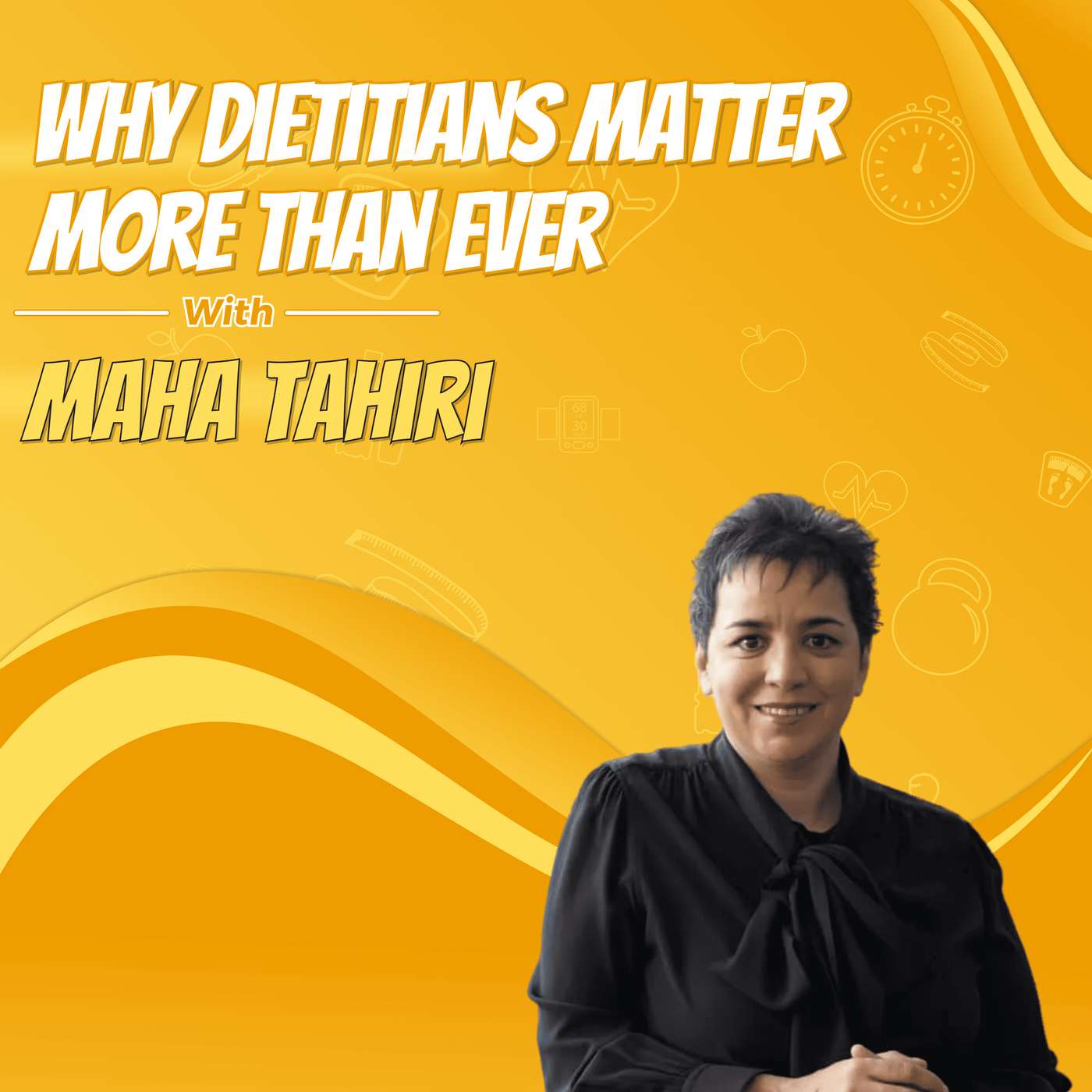
Why Dietitians Matter More Than Ever with Maha Tahiri


 Apple Podcasts
 Spotify
 PocketCasts
 Castbox
 Amazon Music
 Podchaser
 RSS Feed
 Millions of people are now taking GLP-1 medications and losing weight, but is eating less the same as eating better? The answer, according to today's guest, is a resounding no. And almost nobody in medicine, food, or public health is talking seriously about what happens when appetite disappears, but nutritional needs don't.
Join Holly and Jim as they sit down with Dr. Maha Tahiri, a nutrition scientist, food industry strategist, and founder of Nutrition Sustainability Strategies, for one of the most eye-opening conversations in the GLP-1 era. Maha has spent decades at the crossroads of nutrition science, public health, and food innovation, and she's now helping companies around the world rethink what it means to nourish a consumer who's eating dramatically less. Her new company, S2B, is building a strategy for the GLP-1 era and beyond, and she's asking the questions that urgently need answers.
This episode will change how you think about GLP-1 medications, food, and what it truly means to be well-nourished.
Discussed on the episode:
- Why eating less on GLP-1s does NOT mean you're eating better and the nutritional crisis hiding in plain sight
- The alarming statistic about how many GLP-1 users are falling short on fiber, protein, and key micronutrients
- Why Maha calls what's happening to GLP-1 users "medically induced malnutrition" and why that phrase should get your attention
- The one behavior Holly says is now more important on GLP-1s than ever before (not what most people expect)
- Why fiber deserves its own strategy and why lumping it in with protein is a mistake.
- The three phases of GLP-1 use that should shape everything you eat
- What a strange debate in Botswana had to do with Maha's entire career pivot
- The unexpected food category that's actually thriving because of GLP-1 users
- Why the food industry may owe pharma a thank-you and what it needs to do with its second chance
- The role AI is now playing in nutrition advice, and why Maha thinks that's actually good news
- Maha's rapid-fire picks: the most underrated nutrient, the most overrated trend, and the one food she'd put in every kitchen.
00:37 - GLP-1 Nutrition Shift
02:08 - Meet Dr. Maha Tahiri
03:59 - Industry Missed the Human Factor
06:54 - Nutrient Gaps on GLP-1s
11:22 - Eating Patterns and Phases
13:31 - What Nutrient Density Means
14:26 - Fiber Needs Its Own Strategy
15:33 - Micronutrients and Supplements
19:05 - Building a Daily Eating Plan
21:31 - Food Industry’s New Role
24:52 - Companionship, Not One-Size-Fits-All
26:44 - Volume, Value, and Indulgence
28:17 - Product Strategy for GLP-1 Users
30:32 - The Household Ripple Effect
33:45 - AI as Nutrition Advisor
36:51 - Managing Nausea and Cravings
38:29 - Rapid-Fire Nutrition Takes
39:52 - Career Doubts and Lessons
41:48 - Simplifying Nutrition Too Much
42:21 - Dietitians Are Essential
James Hill:
Welcome to Weight Loss And, where we delve into the world of weight loss. I'm Jim Hill.
Holly Wyatt:
And I'm Holly Wyatt. We're both dedicated to helping you lose weight, keep it off, and live your best life while you're doing it.
James Hill:
Indeed, we now realize successful weight loss combines the science and art of medicine, knowing what to do and why you will do it.
Holly Wyatt:
Yes, the “And” allows us to talk about all the other stuff that makes your journey so much bigger, better, and exciting.
James Hill:
Ready for the “And” factor?
Holly Wyatt:
Let's dive in.
James Hill:
Here we go.
Holly Wyatt:
Jim, I think one of the biggest misconceptions in the entire GLP-1 conversation right now is this idea that if people are eating less, they must automatically be eating better. But that's not necessarily true. That's not what we're seeing. We now have millions of people taking medications that dramatically reduce appetite. But people are skipping meals. They're eating two or three bites, and they feel full, and they stop. They're losing weight really rapidly. And almost nobody is talking seriously about what happens nutritionally when volume drops, but nutrient needs don't.
James Hill:
Yeah, that's right. On the medications, your need for protein doesn't disappear. You need vitamins, minerals, you need fiber, you need hydration, and you need to preserve your muscle. All those things don't disappear when you take the GLP-1 meds. If anything, those things become more important.
Holly Wyatt:
Yeah, I agree. And here's where the conversation gets even more interesting to me. The GLP-1 era is not just changing medicine. We talk about that all the time. The field is going to be before and after the GLP-1s. It's also changing food, how food gets formulated, how products get designed, how companies think about portion size, and maybe even how we define nourishment itself. I know last week, Jim, we talked about maybe the guidelines eventually will be redefined based on the GLP-1 era.
James Hill:
Yeah. Well, Holly, we're in luck because today's guest is one of the most important voices thinking about the future of nutrition in the GLP era and beyond. Dr. Maha Tahiri is a nutrition scientist. She's a food industry strategist and founder of Nutrition Sustainability Strategies. She spent decades working at the intersection of nutrition science, public health, behavior change, and food innovation. She just launched a new company, S2B, to help companies in the food and wellness fields develop strategy for the GLP-1 era and beyond. And she's been asking a question that honestly not enough people are asking. What does it actually mean to nourish someone who is eating dramatically less food?
Holly Wyatt:
And what I appreciate about Maha is that she thinks just beyond the nutrient label. Everybody looks at that label that we have, but she thinks beyond that. She thinks about the emotional experience of eating, the behavioral shifts that are happening on the GLP-1s, the food environment, the industry response, and whether the food world is prepared for what's coming next.
James Hill:
Maha, welcome to Weight Loss And.
Maha Tahiri:
Thank you, Jim. Thank you, Holly. Very, very happy to be with you today.
Holly Wyatt:
Yeah. So before we get into the GLP-1 conversation specifically, I want listeners to understand your perspective because you've spent your entire career at this intersection that I think is so interesting now, this intersection of nutrition science and public health and the food industry. And you've watched nutrition evolve from multiple angles at once. So what has that taught you about the relationship between food and behavior and health? What is your experience kind of bringing you to this moment to think about?
Maha Tahiri:
That's a great question. I think we've spent the last 30 years, if not 40, trying to chase what consumers want. And we did in the industry try to do that. We reformulated, we took sugar out, salt, fat, plant-based came in, functional health, etc. But we failed because we were chasing what they want thinking that it was a technology issue, it's a human being issue. And so when GLP-1s came, they actually defined what consumers need. They rewired their brains. And so for all these years of the industry trying to make healthy foods and people accept them, we're now in an era where they are ready to accept them.
James Hill:
That's really interesting because you've worked in some of the major food companies, Maha. I've interacted with you over the years. You've been in some of the really big companies. And you've challenged the industry publicly in many ways. What started you thinking about the nutritional consequences of the GLP-1 medications?
Maha Tahiri:
You want the truth? It started with...
James Hill:
We always want the truth on Weight Loss And...
Maha Tahiri:
It started with a debate in Botswana with an English doctor who told me, you, the food industry, you nutritionists, you should just let us work on obesity and weight loss. You failed. We have a molecule. And I debated him for two hours that anything they have as a molecule will not solve the problem of obesity. I came back and I'm like, Ma, don't be headstrong. There are things that he said that were right. And sure enough, semaglutide was approved in 2017. And I started looking at the medication and looking at the trials. And one thing that struck me is that truly, I was right in a way because medication will not solve this because medication are created. We're medically inducing malnutrition in people who are already malnourished. That's what caused me.
James Hill:
Yeah.
Holly Wyatt:
Yeah. I was about to say, you know, yes, the shift in medicine has made you say people are ready. I said, I don't know if people are ready to be healthy or not. They now don't have to eat as much, but I'm not sure what they're eating is healthy or if they're just eating a lot less of maybe some of the less healthier foods. I mean, I think we don't know that yet, but that's interesting.
James Hill:
I think a lot of people, Maha, in the field felt like, well, on these medications, people are just going to go out and seek healthy food and they're going to go and join the gym and they're just going to be motivated to be healthy. You've really sounded the alarm on some of the potential nutritional problems that people on these medications face. Talk about that a little bit.
Maha Tahiri:
Well, there is not a day that passes now, which really pleases me that we don't have a publication that is talking about nutrition in the GLP-1 world. In the last two months, there are multiple studies that show that in average, people eat around 750 calories. Imagine, 750 calories. 100% of GLP-1 users do not meet the requirements on fibers, 90% not on proteins and many, many other micronutrient deficiencies, vitamin D, iron, the B vitamins, zinc that becomes conditionally decreased because of the iron and less volume and less meat and less proteins that people are eating.
Maha Tahiri:
So yes, we are really getting slowly to know what people are eating, which is really, really what you said, Holly, at the beginning, a lot less. But the nutrient density of what they're eating is becoming now more and more important. If we don't provide a nutrient dense 750 calories to people and potentially supplement, we are really, this is not going to work. This is really not going to work. And so a lot of people tell me taking GLP-1s is cheating. or it's easy. And I'm saying it's not easy. It's not easy because you have to take the medication, deal with the consequences of the medication from side effects, but also you have to nourish yourself properly. So this is not an easy task. We're not handing medications to people and we're seeing a lot of change in behavior.
Holly Wyatt:
One thing people tell me is like, for the first time, I don't have to food log everything because I'm like, no, you now need to food log everything. thing. It's just a different reason that we're food logging. You know, the first time was to make sure we're not overeating or into trying to restrict calories in a certain way. Now it's like we've got to make sure every calorie you eat is nutrient dense and you're getting everything you need. So to me, it doesn't take away some of the behaviors that people don't want to do. If anything, it makes them even more important.
Maha Tahiri:
Yes. It makes them even more important. And I'm going to say it. We need more dietitians in this.
James Hill:
Oh, yeah.
Maha Tahiri:
We really need more dietitians. I was in the UK. I was in Switzerland. You cannot get these medications if you don't have nutrition and behavioral change treatment that goes with the medication. We need people to be guided. They're not thinking about food at all, actually. And so we need someone to guide them and that is what we need to really approach differently. This is not just a medical intervention. This is a medical intervention that absolutely needs to go hand in hand with the nutrition and behavioral and go beyond when people stop. To really cement those habits.
James Hill:
Do you think we're doing a good enough job in helping people understand these issues that they're going to face some nutritional challenges or is it just the Wild West out there and we're giving people medications and saying good luck?
Maha Tahiri:
It depends on who the people go to. There's data from insurance companies showing that when they go to a GP or when they go to an endocrinologist or they go to someone who is really specialized in obesity. All the people who really, the doctors, the practitioners who work on obesity understand the role of nutrition, whereas we're not giving the same really training to all the others that prescribe the medication. So where the medication is prescribed is a really good predictor of whether people will get and we need that to be generalized, not really by specialty. Now, there is one thing that not a lot of people talk about. There is not, I call it the consumer patient, because it's a consumer that goes through different phases. People are changing a lot in the way they are taking the medication. If you look at NielsenIQ data, what people were doing in 2020, 2021, 22, and 2026 is very different in terms of behavior. So we know people are getting more into nutrition, more into healthier. They're recycling. This is the second time or third time that they're taking the medication. They don't come back to medication the same way.
James Hill:
Interesting. Let's dive a little deeper for our listeners who may be taking these meds or thinking about taking them. What are the major nutritional issues that they should think about?
Maha Tahiri:
First of all, I think they need to think about eating. And if they don't think about it, they put an alarm to remind them to eat.
James Hill:
Yeah, people talk about forgetting to eat, right?
Maha Tahiri:
Exactly. I had one doctor who told me one day, I had a patient who came and said she didn't eat for three days. So reminding themselves to have, to still keep a pattern of eating that is consistent is very important. Because sometimes it's just not that they don't want to eat, they don't think about it. And then truly, they need to look for bites that count more, for nutrient-dense products that they still enjoy and eat them. And that's why we launched, you're talking about guidelines, we launched a collaborative to actually create nutrition profiles for all the categories of food and beverages to fit the needs of GLP-1 users at three phases. At the beginning, when they're ramping up, at the middle, when they're stabilizing, and then when they're ramping off, and potentially when they stop the medication. And I think that would be very helpful to the consumer patient, very helpful to dietitians, very helpful to a lot of people to say, okay, well, if I'm recommending this soup, this soup should absolutely have six grams of protein, eight grams of proteins, or four grams of fiber should have these type of minerals and vitamins.
Holly Wyatt:
Yeah, I like that you're thinking about the phases. That's how we like to think about it. Because this is also when people first start, sometimes the types of foods they can eat is different because they do have some nausea. It is hard to eat beyond maybe a few bites. And then that changes over time. And then if you're going off the medication, then it very much changes probably how you want to be thinking about what you're going to be eating. So I really like the idea of phases. The other thing I hear, we're using the word nutrient-dense. I want to make sure our listeners understand the difference between being energy-dense and nutrient-dense. Can you kind of explain that when you say nutrient-dense, what you're talking about?
Maha Tahiri:
I'm talking about the amount of nutrients like protein, fibers, minerals, and vitamins per calorie. Each calorie should carry its weight in terms of what nutrients it brings with it. That is the difference between energy density and nutrient density. And we really have now, like Adam Drewnowski have been working on this for 30 years. We know how to define nutrient density. We have indexes. So it is not something that the world of nutrition is not attuned into and has not been. We have been really talking about nutrient density for 30 years. And now it is taking a dimension of importance that is crucial.
James Hill:
You talk about protein, Maha, and I see protein out there everywhere. You can get protein in your coffee and here and there. What are the other things other than protein that people need to be thinking about if they're taking the medications?
Maha Tahiri:
You touch a really, really dear point to my heart. A lot of people are saying fiber is the new protein. I absolutely disagree with the way of looking at fiber that way. Fiber is not the little boy that protein is going to drag with him or her. Fiber needs a strategy on itself. We have hundreds of fibers that exist. They all have a very different effect. You don't take the same fibers if you have diarrhea or if you have constipation. You don't take the same fibers for stimulating your gut health. So I really would like us to get to the next level of functionality of fibers versus just a number. Fibers do not function like proteins even from a consumer perspective. Consumers looking for that 15, 20, 30 grams of proteins but fiber, the number can be scary if we get too high. So we need to work on the functionality and a functionality by phase because each phase has its own problems and its own benefits that can actually be compensated by fibers.
James Hill:
What about micronutrients? We hear that people should be concerned there.
Maha Tahiri:
They should be. They should be. When you're not getting enough iron, enough calcium, enough magnesium, truly, not only are we depleting on the main functions that these nutrients do, but we know now that, for example, magnesium is linked to inflammation, that a lot of micronutrients have a much bigger role than the initial role that we find in textbooks. And so if you layer the deficiencies to the disturbance of the microbiome, to the disturbance of inflammation, to all of that, that is why all the micronutrients are important and are there.
James Hill:
Should people take a supplement?
Holly Wyatt:
I think even broader than that. What are your feelings about fortified food, supplements, vitamins? Do you recommend using any of those to make sure you're getting those micronutrients?
Maha Tahiri:
Well, first, I would like people to eat real food, and I would like real food to get better. And I have examples of fantastic products that have been launched. I mean, if you haven't tried it, try the Chobani 50, 20, and 30 grams. They are absolutely delicious, and they are packed with protein, with fibers, and there are other products like Vital from Nestle that are actually getting into that phasing. And they have minerals and vitamins, et cetera. So that should be the foundation. The foundation should be up.
Holly Wyatt:
That's a fortified food. Is that considered a fortified food?
Maha Tahiri:
It is a fortified food.
Holly Wyatt:
So Chobani, what was it? It was Chobani. Is it a drink? I'm not familiar with it.
Maha Tahiri:
It's a drink. It's a drink. I highly recommend that you try it. You cannot believe how 30 grams of proteins in a drink and you really, the taste is very good. It's very appealing. And so another thing that we might talk about is the reformulation and taste because the taste of GLP-1 user changes. So I believe foods should become better in terms of their nutrient density and portions and cues for people to eat one two three four five, but I do believe that if need be they need to take the supplements and and the vitamins at least for the phase when they are at 700 or 500, because I really think it's hard to get all the to be like truly on the dietary guidelines if you're eating 500 or 700 calories.
Holly Wyatt:
We do that for bariatric surgery patients. And we're approaching bariatric surgery patients, that may be the amount of calories they eat or even a little less. We know we need to supplement and vitamins and all of that are important. So it would make sense that we would do that if now that we have some of this data coming out that people are eating the amount of calories that are similar to bariatric surgery.
Maha Tahiri:
The only thing I would say about supplements is that I really want that category to be more responsible because we are seeing the wild west in terms of claims. We're seeing boost naturally your GLP-1. Yes, for sure. Anything you eat will boost naturally your GLP-1.
Holly Wyatt:
Right.
Maha Tahiri:
But it's like lighting a candle and being in the bright sun. That is the comparison that I make between eating something that will boost your GLP-1 and truly taking the medication that stays at very high level for a week. So let's not mislead people. The legitimate space for food and supplements is to bridge the gap nutritionally. And that's a big job already to do.
James Hill:
One of the things I like about what you're doing is you get really specific for people. So for people listening to this who are on GLP-1s, you're giving them real specific advice. So walk us through sort of a day in GLP-1 eating. How should people approach their food intake for a day? Should they eat small portions? What do you recommend here?
Maha Tahiri:
I don't think there is a recipe or a recommendation for everyone. As I said before, there are multiple consumer patients on GLP-1, depending on where they are, depending on how they ate before. Again, that's why I think dietitians are important. The frequency of eating is important because the fact that they cannot eat a lot at one setting, it's important that they are really portioning and thinking about this is my day. That thinking in the morning of saying, okay I need to do this so I'm going to have this, this, and this. So that space in the mind of a GLP-1 user is important. Is it three?Iis it five meals, mini meals, or snacks? That really depends on the people and I have enough experience in the industry to tell you not everybody actually can eat right after they wake up. A lot of people can. Some cannot. On GLP-1, it's even worse. Again, I do believe that it's depending on your previous habits, the effect that it's having, the phase. And I cannot be specific with you. This is why we need, again, dietitians. We need dietitians to really understand the behavior of people before, how they're experiencing the medication, how things taste to them.
Maha Tahiri:
GLP-1 has a receptor on the tongue and centrally on the brain. So now we're seeing publications showing that the taste change, what people used to love, they hate now. What they hated, they love. And so it's like less sweet, less fatty. That is very clear that that is the preference of a GLP-1 user. And so it's not as simple as saying, okay, this is the model of what people should have, a model where they need to have this and this and this and this. It's more complicated. and we need to personalize more. And that's why the role of dietitians is important.
James Hill:
You've been very provocative. I've talked to you on many occasions. I've heard you talk about, did the food industry essentially lose to the pharmaceutical industry? Because pharma solved the problem that people cared about in a way that the food industry never did. I think, and I want you to address this, I think we have to think about nutrition differently. We thought about nutrition to lose weight. We don't need nutrition to lose weight anymore. I think we have a different role for nutrition. And I know you're doing a lot of consultation to the food industry. What did the food industry do wrong? What should they do to take advantage of this GLP-1 era?
Maha Tahiri:
Well, first of all, I wouldn't say that the food industry lost to the pharma industry. I would say the food industry should be thankful to the pharma industry because they handed us a second chance. We really failed for a long time. And me included. I'm not saying the others. I have many, many scars of innovation and very few badges because we were not able to deliver foods that people accept and like and get really to the shelf and stay at the shelf for a long time because people were eating them.
Maha Tahiri:
So pharma has now just handed us a consumer that is more ready for healthy foods, thinking more about their health. When someone is on GLP-1, their universe changes. We have data that shows that they buy more decoration for their house, that they buy a pet, that they buy more toys for their pet because they're kind of creating a mini healthy inside their bubble for the beginning because they can't eat outside, because a lot of that. So that is really an interesting space for the food industry. What the food industry did wrong is I do believe in the last 30 years, we really tried, some better than others, but we did not think of this as a human being problem. You know Hilde Bruch's book, it's my favorite book, Obesity, Anorexia, and The Person Within. It's the person within that we have missed for 30 years. And now the person within is even more complex. It's a moving target. And so if there is any learning that we should have from the past is that this consumer is ready, but this is a complex consumer that goes through different phases, that goes through different problems happening at different phases. They don't want to be talking about diarrhea and constipation and nausea to their friends all the time.
Maha Tahiri:
Companies and brands need to become that friend that have their back, that understand them really well, that understand their journey and go with them on that journey. If there is anything to learn that this is a journey, this is not an innovation of one and done.
James Hill:
Are the food companies getting this, do you think? Are they listening when you provide this kind of advice to them?
Maha Tahiri:
So I gave presentation on GLP-1 to the food industry in the last year in five continents. And I call it a tsunami.
Maha Tahiri:
But as you know, tsunami does not hit all geographies at the same time with the same strength.
Maha Tahiri:
I think we're very advanced in the U.S. in terms of understanding, okay, the industry now is really understanding, okay, this is something I really need to think about. I really need to have it in my strategy. There are companies who have been working on strategies for GLP-1 for two or three years. There are others who are not. But I would say the companionship is something that is very difficult for the food industry. I hear a lot of people in my clients say it's a moving target. And it's very difficult to actually see that way and formulate for a moving target. Unless you change your mindset and think about other things that are actually, we've been successful in baby food. We've been successful in pet food. These are two categories that have different phases with different needs. We don't give a baby the same thing from 6 to 12 months to a toddler. And so if the mindset changed, and there are companies that are more equipped for that than others, the companionship brand, the trust that you do with the companion, with your consumer, the relationship that this brand needs to develop with clinicians, the relationship that they need to have with really providing real science, all of that happened in food and pet food. We just have not been able yet to do it for adults. And we can.
Holly Wyatt:
Yeah. So the idea is, I mean, I think we're seeing this, there are people going to be eating less food. And I would think that the food companies, that would be scary. The idea we're going to be buying less food. How is that going to affect the bottom line? So how is that shift? How is that going to affect the food companies? Is it simply they're going to give us less and charge more? Or how are they going to get over this that people are going to need less food potentially?
Maha Tahiri:
This is a very, very interesting question. And this is the nightmare of all the companies. Not the dairy companies. The dairy companies, the ones that are making like really, there are some hero companies, by the way, for GLP-1 users. And dairy is one of them. I was very struck by a press release that was done by Lindt recently, showing that actually the growth of their sales, It's much, much higher with GLP-1 users than with the general population. So the category of indulgence probably will be split into those who provide small portions, less sweet and very premium, and those who continue to just provide calories. Calories that people cannot swallow anymore. And so this question of volume and value, probably it's a parting that needs to be changed in the industry with GLP-1s.
Holly Wyatt:
Right. We're not paying for volume now. And so you were saying, Lindt, that's a chocolate company, right? That makes individually wrapped chocolates.
Maha Tahiri:
Yeah. Or tablets of chocolate that you can actually break into small pieces. And it was one of the aha moments for me because everybody's telling me, oh, no, indulgence company is going to die. The impulse companies, the impulse purchase is much less actually present with a GLP-1 user. They're not going to suddenly stop at a gas station and grab two Snickers.
Holly Wyatt:
Right, right.
James Hill:
I think some of the companies are struggling with the idea of should they go and develop sort of a line of foods for GLP-1 users? Should they look at modifying their whole food line, et cetera? What kind of advice do you give to companies that are thinking along those lines?
Maha Tahiri:
So I just analyzed this. One in five launches in the world that is geared towards GLP-1 is actually a real formulation, a new formulation. Four out of five are a repurposing of an existing product. And that doesn't actually shock me. It shocks a lot of people. Oh, the industry is just wrapping up something and giving it to us. We have been working on weight management for decades. We just were not able to actually get these products to be successful. So it is totally normal that there are products that are existing that actually fit the needs. Now, what these companies actually should be really, really thinking about, it's the flavor and the taste playbook that absolutely changed because the taste of this consumer changed a lot. And so repurposing something, that's fine. Innovating a new product, that's fantastic. But in each case, you really need to take into account the changes in taste because they're not anymore what they were supposed to be. They are more fluid, they change. And I don't think any company understands that yet fully.
James Hill:
Sounds like you're telling companies that rather than think about this as necessarily a bad thing, there may be some opportunities here for companies to move forward.
Maha Tahiri:
There are tons of opportunities. And I really hope the industry will take that because we are going to be in a world of people who are completely, really medically malnourished. If the food industry does not do the job of providing more nutrient-dense, appealing, understanding the taste for the acceptance for each phase which again takes me to the companionship mindset.
Holly Wyatt:
Where I think we're maybe going, which is, I think, going to be a little bit more difficult, is we're going to have people on GLP-1s that are going to want to eat a certain way and have a certain taste and have a certain drive and needs, and then people who are on them and people who are not on them. And that may be very different and the products they need and desire will be very different. So do you think we're going to have like two different grocery stores or two shelves or one product for people on GLP-1s and one product for people not?
Maha Tahiri:
Well, some statistics here. Circana actually showed that 23% of U.S. Households have a GLP-1 user. And that 65% of those households, it's the person taking GLP-1 who decides that they would buy. So there is a ripple effect of GLP-1 user on the household, on the friends, on all the environment. And so I think for sure we're going to, we already see it. There are retailers that have a shelf that says GLP-1 friendly. And so that's happening. But what is actually even more, and undercurrent that is more important, is the impact of GLP-1 user for the entire household.
James Hill:
I see that you have some optimism here that the food industry is going to step up and it may actually improve the health of everyone.
Maha Tahiri:
Well, I think this time they don't have a choice. They don't have a choice. Their only choice is really to understand well their consumers because otherwise they will be eating less of their products. So, you know, Jim, I shared this philosophical thing with you that we have evolved our environment much faster than we have evolved our genes. We're still the caveman. I call it the, now we have the craveman era is gone. Now I am really hoping that by coming up with these medications, we're going to change the environment to even fit better our genes. And it's a fantastic way of thinking of adaptation of the human species that way, because if we, the industry does not have a choice but to take into account the needs of this consumer.
James Hill:
Interesting.
Maha Tahiri:
And they are in a race because the pharma industry started decades ago. I mean, these medications are going to become even more and more and more potent. They are going to try to solve some of the issues that exist during the treatment. In a tsunami, you don't surf a wave. You really need to sit on a higher ground. And that higher ground for me, for companies, is nutrient density, understanding your consumer, changing your innovation teams in a way that actually integrates thinking about an evolving consumer and a moving target, as they call it, into a companionship and many other things.
James Hill:
Wow, fantastic.
Maha Tahiri:
That's the highest level.
James Hill:
Holly, it's time for some listener questions. Do you want to start?
Holly Wyatt:
Yeah, I'll start. And this is a really practical one. And I think our listeners, some of them that a lot of them are on GLP-1. So are there ready-to-eat foods that actually work well for GLP-1 users? Do you have any specifics for our listeners that you think ready-to-eat, good choice for GLP-1 users?
Maha Tahiri:
I think portioned meals that have good nutrient density. I think dairy products that are really high in protein and fibers. And by the way, we didn't talk about that. Most of consumers now ask AI. It's not any more brick and mortar. I call it, it's prompt and mortar so AI is becoming the true nutrition advice interesting a lot of people when they were sitting in their diner room and thinking okay what I'm gonna eat for tomorrow. Now they ask Chatgpt, Cloud, Perplexity, Grok, whomever you name it and so we we can get into really understanding that consumer through ai uh we just launched an answer sink which is a food index that is really first edition is on GLP-1 that goes and really looks at all the prompts that people are asking. People are asking, what type of product should I eat for breakfast? What type of protein shake? Here are the brands that appear. Here's the vulnerability. Here's the visibility. Here's how you get credibility. Here are the sources that actually the LLMs are going to draw the information from.
James Hill:
Wow. So AI is going to replace the TikTok influencer as the nutrition advisor.
Maha Tahiri:
Yes, and that's good news.
James Hill:
That is good news.
Maha Tahiri:
That is good news because all the LLMs are really competing for being trustworthy, for giving the right information, for less hallucinations. So we're seeing them going more and more into authoritative statements, into credible sources.
Holly Wyatt:
I just want to back up. When you said pre-portioned meals, because I know our listeners, I'm going to get this question if I don't ask you. It's going to come to me. What are you talking about? The frozen meals?
Maha Tahiri:
For example, I mean, like Vital Pursuits launched small meals that are high in protein, high in fiber. I think seeing that, look at the protein and fibers first. I would say really these should be two things that we know the vast majority of people, 90 to 100 percent, are missing. And some of that aisle has it. Dairy products, really, you go to the shakes of drinkable yogurt or Greek yogurt or et cetera. They are going to hit on that. And they are now really thinking about fibers also in a big way. And some of them are fortified.
Holly Wyatt:
Got it.
James Hill:
Okay, here's one. What should I do if nausea makes almost every food sound unappealing?
Maha Tahiri:
I know the food industry, the pharma industry is working on that one. But when we did this search actually in the food index, in the beverage food index that we're launching for AI, and we asked for nausea, ginger came back as a hero.
James Hill:
Ah, I've seen that. Yes.
Maha Tahiri:
Ginger came back as a hero, but ginger is polarizing. The prompts that come after that, okay, well, my kids don't eat ginger, don't like ginger, so how do I cook so that I'm, like, this morning I saw Amazon announcing that they are actually improving Rufus in a way that is giving recommendations that actually increases transparency, gives you recipes, increases nutrition. And so you will see more and more the link between what AI is telling people and the compromise. I call it the struggle moment when people ask their first prompt and then they go into “Oh, ginger doesn't work for my whole family.”’ That is the struggle moment where they are trying to compromise. And this is a goldmine for the industry to innovate.
Holly Wyatt:
Yeah. The how I do it. Okay, I now know maybe what to do and I'm willing. It's not as easy as just doing it. There's nuance to it. Yeah. I agree. Should we do some rapid fire, Jim?
James Hill:
Holly's favorite part. The rapid fire.
Maha Tahiri:
Hit me.
Holly Wyatt:
Number one, most underrated nutrient for GLP-1 users.
Maha Tahiri:
Fiber.
Holly Wyatt:
Most overrated nutrition trend right now.
Maha Tahiri:
Overrated…
Holly Wyatt:
Some people are doing it. It doesn't matter, maybe.
Maha Tahiri:
Well, I think proteins are overrated because now I think we need to move from the number to the functionality.
Holly Wyatt:
Okay. One food you'd put in everyone's kitchen.
Maha Tahiri:
An apple.
Holly Wyatt:
An apple. One ingredient that will matter more in a GLP-1 world.
Maha Tahiri:
One nutrient. Why are you single-minded like this?
Holly Wyatt:
Because this is rapid fire. You got to just go with it.
Maha Tahiri:
Pro-fiber.
Holly Wyatt:
Fber, all right.
Maha Tahiri:
I said pro-fiber. I want to give you a word so it doesn't exist.
Holly Wyatt:
Pro-fiber, all right. Biggest mistake the food industry is making right now?
Maha Tahiri:
The biggest mistake the food industry is making right now is thinking that they're formulating one product for one consumer. It's multiple product companionship for multiple phases of a consumer.
Holly Wyatt:
Like it.
James Hill:
Well, the next segment, we close with what we call the vulnerability segment. These are questions less about science and more about the person behind it. And I'll ask the first one, Maha. I've known you for a long time. Was there a time in your career where you genuinely questioned whether you were on the right path?
Maha Tahiri:
There was a time where I genuinely ask whether I am on the right path. I went into this path because I wanted to make impact at scale. And you say these things to yourself when you're 18, you don't really know what it means. And you refine it as you go. More impact with scale, that meant working for the food industry because I was in the nutrition field. I have seen highs and lows in nutrition. And unfortunately, there were times where there were reversals of some of the improvements that we were done. Really, I asked myself, it takes 10 years to get people to really decrease by 10% or 15% their sodium. It takes a minute to bring it back. We have data coming from Canada showing that actually during COVID, there was a role of reversal of reformulation, healthy reformulations. So there were times where I was like, I think I should be somewhere else. And being from the outside and influencing from the outside, I really feel like the companies are listening more.
Holly Wyatt:
Well, I can tell that you're you're definitely more optimistic that good things are coming. Here's a little follow-up to that vulnerability. I like to ask a lot of our our guests this. What's something.. and I guess maybe for you it's a nutrition message that you got wrong. I mean, that we thought we put it out there and then later you said you know that maybe wasn't the best message. We didn't have the science quite right yet or…
Maha Tahiri:
In the U.S we have this dichotomy between hero ingredients and evil ingredients. It's almost like religious like you we need a god and we need a devil. And I think something we did wrong is whenever there was a trend, we kind of like amplified it. Okay low fat, go with low fat, low fat, low fat. Oh, no. No sugar. We confuse people because we oversimplified.
Holly Wyatt:
Yeah. Oversimplified. We say that all the time.
James Hill:
I agree 100% with you. Okay, Maha, what I'd like for you to do is to tell our listeners, what's the one thing you would like them to take away from this conversation?
Maha Tahiri:
These medications are fantastic. They are not going to deliver what we want them to deliver without nutrition and behavior. We need dietitians. We need guidelines. We need profiles for categories to make the industry responsible. These medications will not work without nutrition.
James Hill:
Wow. Wonderful message. And we tout dietitians right and left. I think every prescription for GLP-1 med should come with a prescription for a dietitian as well.
Maha Tahiri:
I 100% agree with that.
James Hill:
They can make such a difference in the experience, both in managing the side effects and getting healthy nutrition. It's a wonderful time for dietitians to step up.
Maha Tahiri:
It really is. And I think we need them. We need to elevate their role. We need to really, really see them as true practitioners that are as important as a doctor in this journey of a GLP-1 user.
James Hill:
Absolutely. Maha, I love what you're doing, particularly working with the food industry. And I know because I work with the industry too. They're all struggling to figure out a path forward here. I think they understand it's a sea change. I don't know that they quite know what to do with it, but it's great that people like you are out there working with them to help develop strategy that's going to make everybody healthier, not just GLP-1 users. So, thank you for your time. This has been a wonderful episode. We've really enjoyed it. And see you next time on Weight Loss And.
Holly Wyatt:
Bye, everybody.
James Hill:
And that's a wrap for today's episode of Weight Loss And. We hope you enjoy diving into the world of weight loss with us.
Holly Wyatt:
If you want to stay connected and continue exploring the “Ands” of weight loss, be sure to follow our podcast on your favorite platform.
James Hill:
We'd also love to hear from you. Share your thoughts, questions, or topic suggestions by reaching out at weightlossand.com. Your feedback helps us tailor future episodes to your needs.
Holly Wyatt:
And remember, the journey doesn't end here. Keep applying the knowledge and strategies you've learned and embrace the power of the “And” in your own weight loss journey.