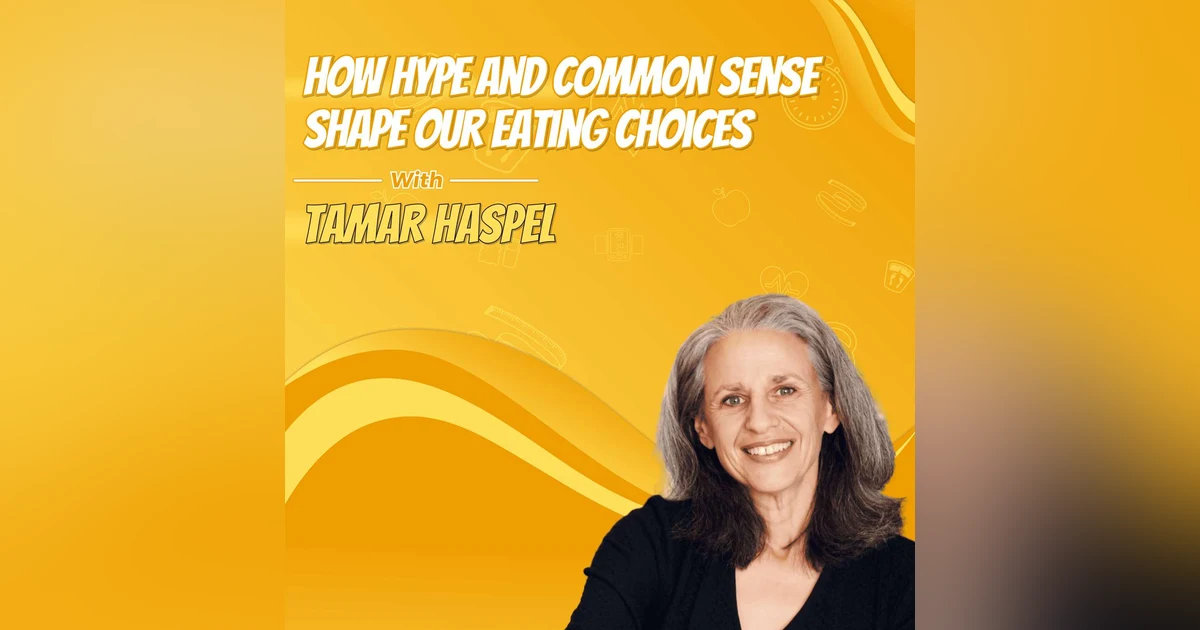
How Hype and Common Sense Shape Our Eating Choices with Tamar Haspel

 Apple Podcasts
 Spotify
 PocketCasts
 Castbox
 Amazon Music
 Podchaser
 RSS Feed
 For 40 years, every time nutrition has found a new villain, the food industry has handed us a new label to go with it: non-fat, no GMOs, gluten-free, no seed oils, and now, non-ultra-processed. We have more experts, more studies, and more food rules than ever before, so why does standing in the grocery aisle still feel like such a guessing game?
Join Holly and Jim as they sit down with Tamar Haspel, the James Beard Award-winning Washington Post columnist behind Unearthed and author of To Boldly Grow, to pull apart the ultra-processed food debate and ask whether today's labels are actually helping us eat better or just making us easier to market to. Tamar doesn't just write about food from behind a desk: she gardens, fishes, raises chickens, and runs an oyster farm on Cape Cod, and she brings three decades of reporting, real skepticism, and zero patience for diet cranks to the conversation.
You'll hear why the food world keeps repeating the same mistake, what a cage full of B.F. Skinner's pigeons can teach us about our relationship with food, and what's really driving overeating once you strip away the marketing.
Discussed on the episode:
- The decades-old pattern that explains why every new food "villain" feels eerily familiar
- The bizarre pigeon experiment that reveals why we're so convinced certain foods are "good" or "bad" for us
- Why a bowl of crushed cereal proved more about overeating than years of processed-food headlines
- The blunt case for why "everything in moderation" might be the most useless diet advice out there
- The one-sentence grocery store rule that could replace almost every food label you've ever side-eyed
- How GLP-1 medications could end up reshaping the entire food industry, not just individual waistlines
- The "healthy" nutrient claim, Tamar says, is wildly overrated and the snack everyone blames for something it's not even guilty of
00:37 - Labeling the Food Confusion
04:28 - Why Nutrition Feels Contradictory
06:53 - The Trap of One-Thing Answers
11:34 - The Ultra-Processed Food Debate
19:16 - Calories Drive Consumption
24:25 - GLP-1s Change the Game
31:03 - The Vegetable Problem
35:09 - Can You Trust Labels?
36:25 - Rethinking Kids’ Food Choices
37:35 - Is Moderation Useful?
40:03 - Rapid-Fire Food Confessions
45:58 - What Tamar Got Wrong
James Hill:
Welcome to Weight Loss And, where we delve into the world of weight loss. I'm Jim Hill.
Holly Wyatt:
And I'm Holly Wyatt. We're both dedicated to helping you lose weight, keep it off, and live your best life while you're doing it.
James Hill:
Indeed, we now realize successful weight loss combines the science and art of medicine, knowing what to do and why you will do it.
Holly Wyatt:
Yes, the “And” allows us to talk about all the other stuff that makes your journey so much bigger, better, and exciting.
James Hill:
Ready for the “And” factor?
Holly Wyatt:
Let's dive in.
James Hill:
Here we go.
Holly Wyatt:
Jim, for the last 40 years, every time nutrition found a new villain, something to point their fingers at, America got what we're calling a new food label. So we started labeling things non-fat, or we would say no fat in this product, or no high fructose corn syrup, No GMOs, no gluten, no seed oils. And maybe even now we're starting to say non-ultra-processed. We're labeling things that way. We have more labels than we ever have, more nutrition advice than ever, more experts, more studies, more podcasts, influencers, apps, and more food rules than we've ever had before. And people, I think, are still standing in the grocery aisle, and I will include myself in this sometimes thinking, I have no idea what I'm really supposed to eat.
James Hill:
Well, Holly, you're in luck because this is the problem we're talking about today. Are labels helping us eat better? Are they making us more confused, more anxious, and easier to market to? Now, we have a guest today. Holly, I've been very excited about this episode. Who's one of the best people to help us think this through. Tamar Haspel writes the James Beard award-winning column Unearthed for the Washington Post. She covers food, agriculture, nutrition, obesity, food policy, and the food environment. She's also the author of To Boldly Grow. And Holly, she doesn't just write about food. From behind a desk she gardens, fishes, raises chickens, and even has an oyster farm on Cape Cod. I must admit, I'm a fan. I read her work, and I am so impressed with people that can take complex subjects and write it in a way that gives you some simple conclusions.
Holly Wyatt:
Yeah, and she walks the walk. She walks the walk. What makes her so valuable is I think she sits between that science and real life, and that's what we really like. She asks the questions that, you know, regular people are asking, but she brings evidence to them and skepticism and some common sense to the table. So welcome to Weight Loss And. We are so excited to have you.
Tamar Haspel:
I'm delighted to be here, Jim and Holly. Thanks so much for inviting me.
Holly Wyatt:
Before we get into these labels and our discussion kind of about ultra-processed foods, I want to give you an opportunity to tell our listeners what you do and what you're trying to accomplish with your column.
Tamar Haspel:
I write about food where it intersects with science. So basically, what we eat affects us and our planet. And I do it because I actually think it's important. It's certainly important to me. And I come to this with a history of having struggled with my own weight when I was younger. And that gave me firsthand experience with what being overweight can do to you, how it makes you feel, especially as a young woman (which I was when I was overweight), it can affect every aspect of your life. There's some days, I have to admit, when you look at the problems in the world, and losing weight in the first world seems like a first world problem and sort of trivial compared to some of the things that are going on in the world today. But to me, it was always important. And I think that it's important to other people as well.
James Hill:
Wow. So you have covered this area for a long, long time.
Tamar Haspel:
Long, long time, Jim. Don't you dare say how long.
James Hill:
No, wait, I'm older than you. Come on. Holly gives me grief about my age all the time, but we're still in there. We're still hanging in there.
James Hill:
We hear this all the time and we've heard it for decades from the public. Why is it so confusing? Why do you nutrition people tell us one thing one day and another the next day? Have you made sense out of this?
Tamar Haspel:
Well, it's taken me, alright, I'll say it, 30 years.
Tamar Haspel:
But yeah, I think I have made sense of it, but I can understand why people are confused because it took me 30 years of being knee deep in it to really try and understand not only what's going on in the food world, but what's going on… I think Americans have gotten sort of a one two punch. The first is that the people who sell us food stock the world with foods that we have a hard time resisting. But then there's another group of people selling us solutions that are in some ways just as insidious as the products themselves. Because, you know, Americans have a long and storied history of latching on to any diet advice that lets them eat the things they wanted to eat in the first place. And of course, there are lots of people, both straight-up scientists as well as grifters and scam artists who are looking for an answer for people. Sometimes they're looking for an answer because they genuinely want to help. Sometimes they're looking for an answer because they genuinely want to sell something. And sometimes it's a little bit of both. So we've ended up in this mess where this one-two punch of a food environment that's obesogenic and then a bunch of answers that don't answer the question leave us with our hands up in the air and consumers saying, what am I supposed to eat already?
Holly Wyatt:
Yeah. So why do we keep cycling through these villains? It's like as soon as we kind of identify one, we then move on to the next one. And that's one of the things I think is so confusing. It's like you told me it was this and now you're telling me it's this and then tomorrow there's going to be something else.
Tamar Haspel:
Because we have a bad case of one-thing-itis.
James Hill:
Oh, Holly, Holly, let's emphasize that. Tamar, I get asked all the time, what's the one thing we can do to solve this problem? And it's quit asking about one thing.
Tamar Haspel:
Right. And so, but you can see why people want to do it. I mean, so the three of us, we spend our whole lives embroiled in food. We pay attention to all of the studies. We talk to people all the time. We read. We are knee deep in this constantly. And so, of course, I would hope after all of this time, have some more nuanced answers and have sort of hopefully had some time to wrap our minds around some of the complexities. But think about what happens when we go out in the world and talk to people who are experts in other things about things we know nothing about. So I'm like, “Okay, yeah, tell me the one thing we have to do to solve the U.S. health care problem. Or Ukraine or interest rates.”
James Hill:
And the problem is everybody who eats thinks they're a nutrition expert.
Tamar Haspel:
Yeah, that's true too. I had a friend who once said that everybody thinks they can write because they can write the grocery list.
James Hill:
I love it. I love it.
Tamar Haspel:
And, of course, but with food, it's a really good point because it's super personal, that we eat and then we experience things, whether it's good things, we feel like we have more energy, or bad things, we feel like we have less energy or we don't feel well or we get a disease. And because humans are wired for causality, we draw these connections between the foods we eat and whatever it is that happens to us. So do you know about B.F. Skinner's pigeons?
James Hill:
Oh, gosh, yeah. I'm a psychology major. I grew up on… I visited his office one day.
Tamar Haspel:
Did you really?
James Hill:
Many years ago. Yes. He wasn't there, but…
Tamar Haspel:
So you know this experiment. It's a crazy experiment. So B.F. Skinner, the famed animal behaviorist, put pigeons in cages. Yes. And he would drop pellets of food down at completely random intervals. But the pigeons were convinced that something they did made the pellet come down. And so whatever they happened to be doing when the pellet came down, that's what they would do. They would hop on one foot. They would flap their wings. They would turn around. They would peg at the floor, whatever it was. And so if you think about that pigeons are wired for causality in this way, imagine how deeply ingrained it is in us humans. And so, we are just prepared to see what we eat causing how we feel. And Holly, this comes back to the question that you started and now we've wandered far away from, which is about one thing. If you give people a change to make a one thing change, don't eat carbohydrates, cut out meat, reduce your saturated fat, don't have any sugar, whatever it happens to be, people are almost always going to feel better because they're probably going from a diet that's a little less good to a diet that's a little more good, but it also could be placebo effect kicking in. They feel like they're taking control of something. And so any one thing will get traction out in the universe because people do it and all of a sudden they feel better. But that's just because they're doing something.
Holly Wyatt:
Right. Empowerment. I'm making a change.
Tamar Haspel:
Exactly. That's exactly right. Empowerment. And believe me, I am all in on empowerment. But sometimes, especially with social media now and people being able to sort of reach a lot of people with this one thing that they've done, it can also, a first-person anecdote can be extremely compelling to people. I did this and I lost 30 pounds or whatever it is.
James Hill:
So Tamara, we did a whole podcast on that recently. The anecdote, the power of the anecdote. My friend did this and lost 30 pounds, so I need to do it.
Tamar Haspel:
And I've actually thought about writing a book, N equals one.
Holly Wyatt:
We talked about that, N equals one. And because it happened to a person, it's real. I don't think people are trying necessarily to scam. They're like, this happened to me. It's real. I want to share it because it mattered to me. And that's hard, especially if you know that person. I mean, we have the influencers out there, but sometimes it's your best friend or it's your mom, you know?
Tamar Haspel:
Exactly.
James Hill:
There's so much I want to talk about, but I do want to talk about a column you wrote recently, which I thought was brilliant about ultra-processed foods.
Tamar Haspel:
I wish you'd weigh in on the comments because they never say that in the comments.
James Hill:
Never read the comments. These are idiots out there sometimes. But walk us through how you took a look at the idea of ultra-processed foods.
Tamar Haspel:
So ultra-processed foods are the labeling issue.
James Hill:
The labeling issue.
Tamar Haspel:
The labeling issue. Okay. We can talk about ultra-processed foods till the cows come home. But let's talk about the labeling issue. And I want to start with a little history because we all remember SnackWells.
James Hill:
Totally. We use that as an example all the time.
Tamar Haspel:
All the time. And I've known Marion Nestle for many, many years. And we have talked about this a lot because she was part of the Dietary Guidelines Committee that first started writing about lowering fat. And her assumption and the assumption of the people on the Dietary Guidelines Committee was that, okay, if you told people to cut out some fat, they would eat foods that have less fat in them. And the things that have a lot of fat in them are fatty meats, baked goods, generally things that aren't, terrifically healthful, although fat can be perfectly healthful, but they never anticipated SnackWells. And all of a sudden you get this line of low-fat cookies and they just flew off the shelf. And Jim, you and I are old enough to remember this.
James Hill:
I totally remember.
Holly Wyatt:
Oh, I do. I bought them. I bought them. Oh, yes. I worked with my weight my whole life. So I was they're buying them just like everybody else.
Tamar Haspel:
This problem has played out in every single one thing villain scenario that we've had. And it says a couple of things that I think are important. First is, and I said this before, people will latch on to any advice that allows them to eat the things they want to eat anyway. But there's something else here that I think doesn't get talked about that is absolutely super important. And I use a commencement address that Richard Feynman gave at Caltech in 1974. four. And he talked a lot about pseudoscience. And this was the Uri Geller era with the bending the spoons. And he talked about mysticism, but he also talked about studying questions that are just really hard to answer. He used the example of how do we best teach kids to read? Okay, we can study that, but it's hard to study. It's hard to study well. And if you think about nutrition, it's exactly the same. It's very, very hard to study well. I don't think people generally have an appreciation of how difficult it is to study what's optimal for humans. We know exactly what rats should eat, but we can do things to rats that the review board would frown on if you wanted to do them to humans.
Tamar Haspel:
And what Feynman said was, when science claims an issue for its own, even if it doesn't have good tools, it doesn't have good answers, it disenfranchises ordinary people from using ordinary good sense to solve their problem on their own. If you ask yourself, what would you eat if we had zero information about nutrition? The answer is, okay, well, we do know that the human body needs all kinds of different nutrients, but we don't know which ones or in which quantities. And so your best bet would be just like if you were building like a financial portfolio, variety of foods with their nutrients intact. And that's the best hedge that you have against uncertainty. But people turn that off when they're told that “no, saturated fat raises LDL cholesterol and LDL is causal for heart disease.” And that's actually a good example of something, but if they get told that gluten is the root of all evil, you turn off the parts of your brain that try and make sense of the food environment.
Tamar Haspel:
And humans, as a species, we ate our way to planetary dominance with absolutely no expert assistance. And we've been feeding ourselves and our families since the primordial ooze. And it's only lately when we have this food environment that's crowded with things that tempt us away from sensible choices that this has been a problem. So let's go back to the labels. So what the labels do is play right into that tendency that we have. It was funny because gluten-free was a really big deal for a while, maybe about, what, 20 years ago, 15, 20 years ago?
James Hill:
Yep.
Tamar Haspel:
And one of the reasons people latched onto it was weight loss. And, of course, it made a lot of sense because if you don't eat gluten, well, you don't eat bread, you don't eat pasta, you don't eat cake, you don't eat cookies. You don't eat all kinds of things. But then as soon as we started to see products, cakes, bread, pasta, that were gluten-free, all of a sudden, the low gluten diet didn't work for weight loss anymore.
James Hill:
That's a great example.
Holly Wyatt:
Well, it's the SnackWells all over again, right?
Tamar Haspel:
Right. It's the SnackWells all over again. This is all about people finding a reason to eat what they want to eat. And this is about the food industry giving people permission to eat the thing they want to eat.
James Hill:
In your column, you raise some potential concerns about labeling foods as ultra-processed. Tell us about that.
Tamar Haspel:
Processing is a tool. If I have a hammer, I can help my neighbor fix his roof or I can kill his dog. If you have a tool, if you have processing as a tool, you can create all kinds of diabolically delicious shelf-stable temptation foods, or you can make a better lentil soup. And if you're the food industry, obviously, you're going to use processing to create foods that people want to buy. What foods do people want to buy? They want to buy foods that are tasty, cheap, and convenient. And we know that from customer surveys over and over and over again.
James Hill:
Taste, cost, convenience. They always come out as the major drivers.
Tamar Haspel:
Yes, they do. And health is sort of a distant form.
James Hill:
Health is in there, but it's not in the top.
Tamar Haspel:
Right.
James Hill:
One of the things that's always bothered me about the ultra-process label is, I'm not convinced that it would be telling people to eat differently than we're already telling them to avoid foods that are high calorie and high in sugar, fat, and salt.
Tamar Haspel:
This is the thing. Okay, now, can we get in the weeds just a little bit?
James Hill:
Absolutely. Go for the weeds.
Tamar Haspel:
Because one of the biggest, biggest drivers of consumption, and we know this from Barbara Roll's seminal work in the 1990s and beyond, is calorie density. And so when Kevin Hall did that famous study with highly processed foods versus minimally processed foods, and for anybody who's listening to this who's not familiar with this study. It was a metabolic ward study. So he put people in a tightly controlled condition. He fed some people a highly processed diet and he fed some people a minimally processed diet that were matched for macronutrients and all kinds of other things. And you can eat as much as you want. And they simply figured out how much people ate. And people on the highly processed diet ate 500 calories more per day, which is a lot, than minimally processed diet. And this was widely read and is still widely read as an indictment of ultra-processed foods, which, of course, on his face, it is. And I remember talking to Kevin Hall right after that study came out, and I asked him, “Why? What was driving this?” And his number one assumption, his number one speculation, because, of course, the study wasn't designed to capture this, was calorie density. And so he had been doing a follow-up study when he left the NIH that did control for calorie density.
Tamar Haspel:
I had only seen preliminary reports, and I don't even know if the final results are ever going to see the light of day at this point, but he released preliminary results that showed that the difference between consumption of ultra-processed versus minimally processed foods went away when you controlled for calorie density.
James Hill:
I've talked to Barbara Rolls many times about this. She's totally convinced the effect wasn't due to anything related to processing, energy density. And so the way I look at it is you can have processed foods that are healthy and processed foods that are unhealthy. The processing itself is not the bad guy. The end result is what matters.
Tamar Haspel:
And that's true. But that said, almost all of the highly processed food out there in the world is not great for you. Why? Because that's the food that we are being sold because it's the food we prefer. While I will rail against the food environment until the cows come home, we as consumers are not so much victims as we are co-conspirators.
James Hill:
I could not agree with you more. There's responsibility on both sides, on the industry side and the consumer side. And yet we want to blame somebody back to the problem. We want to blame one person that's causing the problem. Food industry clearly has a role here, but I think we somehow have to move the food industry in the right direction because at the end of the day, they're going to be providing the food we eat.
Holly Wyatt:
Well, I think it comes down to also, people would prefer to blame the processing and the food environment. It's not as sexy to say, “Oh, it's all about energy density. It's all about calorie density.”
Tamar Haspel:
Nobody wants to hear that.
Holly Wyatt:
And even experts, even scientists, when they present that data, I'm like, but that study, they present that. I'm so glad you went in the weeds and talked about that study because that is such a pivotal study we talk about. And then I'm like, but it wasn't controlled for energy density. So energy density could be the driver of, and they're like, well, we don't want to talk about that.
Tamar Haspel:
It's boring. It's wonky. I have to plug Barbara Rawls. She's awesome. And she did one of my absolute favorite, if you're not convinced about energy density, one of my all-time favorite experiments, that and BF Skinner's Pigeons, was she did this super elegant energy density study by taking Wheaties and crushing them. And so literally the only thing different between a whole Wheatie bowl and a crushed Wheatie bowl is energy density. It's exactly the same food. And once the Wheaties were crushed, people ate way more of them, even though crushed Wheaties are not super appetizing. And that was the best proof of energy density I've ever seen.
James Hill:
I think energy density is one of the major determinants of food intake. And I agree with you. It's not sexy, but we have so much data showing that energy density plays a role in food intake.
Tamar Haspel:
And nobody I know disagrees that energy density is a driver of overconsumption. They argue about other things, carbohydrates and protein content, all kinds of other things. But I don't think anyone disagrees that energy density is a major driver of overconsumption. It's not the only one. I mean, there's palatability, ubiquity, convenience, price.
James Hill:
Oh, yeah.
Tamar Haspel:
A million other things.
James Hill:
I wonder, gosh, there's so many directions we could go here, Holly. But I want to change gears a little bit and ask you about what the new GLP1-based medications have done to how consumers think about food.
Tamar Haspel:
I think they should put them in the water.
Holly Wyatt:
Wow.
Tamar Haspel:
I think these new drugs are astonishing. And I have been covering obesity for, like I said, decades. And the idea that now we have an effective drug that seems to be quite safe, although, of course, we have to keep our eye on that especially as newer versions come out, that they are, it's fabulous. And I think this is a fitting way. Some people say, this is a shortcut.
Tamar Haspel:
This is just an arms race between the food industry and pharma. But to me, it seems entirely appropriate because the reason we have an obesity problem, is that we go out in the world 24-7, we're faced with engineered temptation. We are surrounded by foods that are specifically designed to be overeaten, specifically designed to appeal to us. And so it is fitting that the way we solve obesity is to counteract engineered temptation with engineered resistance. And I don't think we can expect humans to resist this rampant food temptation out in the world. I mean, evolution did not endow us with any upside protection on obesity because it was never a problem that humans faced.
James Hill:
It was an advantage. We talk all the time about a lot of people we work with will come and sort of whisper aside, I have to tell you I'm on the medications as if it's a bad thing and, you shouldn't do it, but we call it leveling the playing field. Look, you are at a disadvantage, for whatever reason your biology is working to cause you to eat more. This is a tool that levels the playing field. Holly has often said, we need a pill which will help people who haven't experienced food noise experience it so they will know what it is.
Holly Wyatt:
Right, because you don't know what you don't know and you haven't experienced. So I love this thought. And you put it in such a way that I think people will get it. So how do you think the GLP-1s are going to push, I'll even say force, the food industry to rethink what it's selling? How do you think it's going to impact the food industry.
Tamar Haspel:
So I've been on record on this for a couple of years because I think that eventually, the GLP-1s will transform the food environment. Because the reason that we get sold all of these tempting foods in huge quantities and large portions is because that's what we buy. That's what we want. That's how a food company can make money. And when the GLP-1s change the nature of demand, that's going to change the nature of supply. All of the previous efforts to change the food environment have been these top-down, in this country.
Tamar Haspel:
Milk-toast ways to try and rejigger food around the edges, any kinds of labels, any kinds of taxes, any kinds of restrictions on advertising. But we know from countries where they have done more rigorous sets of controls, like in Chile, for example, that it basically doesn't do anything anyway. And it's very, very difficult for a government, particularly in a free society, to regulate something when a food corporation wants to sell it and a consumer wants to buy it and it's not actually dangerous, and we can have the conversation about the difference between being dangerous in quantity and being dangerous you know for dinner. And so given that, we really can't change the food environment in any significant way, in a regulatory way. Changing the nature of demand is the best shot that we have at doing this. I mean, capitalists want to make money. And when people start en masse asking for different things, that's what they're going to provide.
James Hill:
I think the whole GLP-1 revolution is causing us to rethink nutrition. For most of my life, nutrition has been about what to eat to lose weight. And now the medications do the heavy lifting. But I think there are other ways that nutrition can contribute to health without having to produce weight loss. And I think that is going to force the companies to change what they deliver. People are eating less, so they need better nutrition and less food to maintain optimal health.
Tamar Haspel:
And I hope that you're right. I think that people are much less attuned to the nutritional quality of their food than they are to weight and weight loss.
James Hill:
I agree.
Tamar Haspel:
I mean, it's such a big issue.
James Hill:
But we're seeing now nutrient deficiencies in people on the medications because they eat so little food and they don't get the adequate nutrition. So I think we need to look at some of those issues too.
Tamar Haspel:
I think that's super important. And for the moment, I am happy to trade the problem of obesity for the problem of some nutrient deficiency.
James Hill:
I love it. I love it.
Tamar Haspel:
That is a public health win. But of course, I don't want to minimize those problems either.
James Hill:
Absolutely.
Holly Wyatt:
Well, I think, you know, we've been talking about energy density. The GLP-1s may move us to talk about nutrient density, which is independent.
Tamar Haspel:
Although, Holly, if you think people don't want to talk about energy density, you sure as hell don't want to talk about energy.
James Hill:
But that raises the question, can we give it to them even though they don't know they want it?
Holly Wyatt:
Oh.
Tamar Haspel:
Okay, this is really hard because basically it's the vegetable question.
James Hill:
How do you make people like vegetables?
Tamar Haspel:
And people don't like vegetables and I really wish, we could come to terms with that. I remember being, I was in a meeting, I don't even remember what it was. At the Boston Museum of Science and the guy who had started what's it called the Clover Food Lab? I think it is.
James Hill:
Oh, I've heard of that.
Tamar Haspel:
It's a vegan.
James Hill:
Yeah, yeah.
Tamar Haspel:
And they're right across from my cardiologist in Boston. I always eat there when I have a chance. I think it's terrific. He was making the case that people don't eat vegetables because, you know, they've never had a perfectly roasted carrot. Okay, I'm all in on perfectly roasted carrots. But people won't prefer those to Doritos. They just won't. They just don't. Doritos are specifically designed to appeal to everything about what humans like to eat. And roasted carrots are just sort of the best you can do with a carrot.
James Hill:
I love it. I love it.
Tamar Haspel:
So, no. People are not going to eat a lot of vegetables. But let's say on the plus side here, we actually don't really know how much of most nutrients people need. We understand deficiency diseases, scurvy and rickets and beriberi. We know that there are some diseases people get if they don't have a certain level of a certain nutrient. But how much vitamin K do people need? We have no clue.
Holly Wyatt:
Right.
Tamar Haspel:
And so I think that the basics of a healthful diet are just whole-ish foods that have their nutrients intact. And I think that there's a wide, wide world of foods that fit that description, and people can choose the ones that they want. Even with GLP-1s, I really think trying to get people to eat more vegetables is a losing battle. I mean, if you look, that's probably the single most reiterated piece of dietary advice. It's been reiterated for a good half century. But if you look at data on American vegetable consumption, it's a flat line.
James Hill:
We've barely moved the needle. You have to torture the data to find any good stuff at all.
Tamar Haspel:
It's a flat line. And so how often do we want to flog this dead horse before we realize that, yeah, sure, eating vegetables is a great hedge against what we don't know because it has a lot of what we need, which is nutrients, and it doesn't have a lot of what we don't need, which is calories. But again, Holly, as you point out, the calculus changes on that as GLP-1s become more widely used.
Holly Wyatt:
Yeah, I think this is the first time, like what you're saying, we have a big, something that's out there that's going to move the needle and change from a physiological standpoint how much food we're driven to eat. And therefore, it changes everything. So this is this critical time. And I agree, the vegetables aren't sexy at all. How do we make this sexy? How do we, what do we do?
Tamar Haspel:
You don't. You got to give it up, Holly. You got to give it up for the vegetables.
Holly Wyatt:
How do we eat then sexy?
Tamar Haspel:
You know how you make vegetables sexy and delicious? With cheese.
James Hill:
Everything's better with cheese.
Tamar Haspel:
And bacon.
James Hill:
All right, Holly, we could go on and on here, but we have some great listener questions. Let's do a couple of those for tomorrow.
Holly Wyatt:
All right, you start, Jim. Start with one.
James Hill:
Okay. When I'm standing in the grocery aisle, can I trust any label at all?
Tamar Haspel:
No. The answer is no. So my husband Kevin, he has this idea that I think should be mandated. His idea is that you can put absolutely anything you want on the label, but it has to be in a font half the size of the things that you're allowed to say on the label. So you look at the label and you know that everything small is just marketing BS and everything big is actual information.
Holly Wyatt:
I love this. If you've got to get out your readers, then you just know.
Tamar Haspel:
That's right. That's right. You know. And I think this is a genius solution to the labeling problem. But when you go to the grocery store and you look at a label, here's the one thing you should be thinking about. That label is there to try and make me feel good about buying and eating this package. And chances are, if you have to be talked into it by a label, it wasn't a good choice in the first place.
James Hill:
I love it. I love it. All right, Holly, you go.
Holly Wyatt:
All right. Here's someone. This is, I think, parents. Parents are trying to figure out what to do, what to feed their kids. How should parents think about ultra-processed foods without losing their minds? How should they be addressing this?
Tamar Haspel:
I think parents should not think about ultra-processed foods. I think parents should think about the things that make foods good or not so good. If your kid is struggling with his or her weight, then you have to think about calories. If your kid is an athlete, then maybe you have to think about calories in the other way and making sure that they get enough. And again, go back to this basic idea that we need whole-ish foods, foods that have their nutrients intact in a wide variety. That eliminates a lot of processed foods right off the bat without even talking about processing. Does this food resemble the food when it grew on the tree or in the ground or, in the animal that it came from? And if the answer is yes, then it probably has its nutrients intact. If the answer is no, then it probably doesn't.
James Hill:
Okay, here's one for you, Tamar. Is moderation actually useful advice?
Tamar Haspel:
I wrote about this a long time ago. I think it's the worst diet advice that ever was. Because if I had the ability to be moderate, I wouldn't be in this jam in the first place. So, it's like telling somebody that the way to be a concert pianist is to be a concert pianist. And it doesn't give you any clue about how to get there. And so, no, the ability, okay, so here I am. I, as I said, I have struggled with my weight, but not for many years. I was overweight when I was a young adult. And the way that I manage is to just basically create my own food bubble. Because if there are cookies in the room, if there's ice cream in the freezer, there's chips in the pantry, they will call my name. Tamar, I'm in the pantry. And I don't have the ability to be moderate. So shut the fuck up. And so telling people to just eat less of everything is just, it's not actionable.
Holly Wyatt:
Yeah, I agree. I say this all the time, the intuitive eating movement. And I've been like, if I just go with what my mind tells me, I will be eating chips every day. That's my thing. It's like chips, chips, chips.
Tamar Haspel:
I've been thinking about banana splits all morning.
Holly Wyatt:
Totally agree with you on this one. And I think people who've struggled with their weight, I also struggled when I was younger and I still have to work on it.
Tamar Haspel:
Every day.
Holly Wyatt:
Every day.
Tamar Haspel:
I think about it. Holly, it's so weird because I have not been overweight in probably 30 years, but I was overweight at a seminal time as a young adult. And I still have fat girl deep in my DNA. And I will walk by a shop window and catch a glimpse of my reflection. And my first intuitive thought is, huh, I'm not that fat. It sticks with you. That's how powerful it is.
James Hill:
All right, Holly, it's time for your favorite part of this episode. The rapid fire.
Holly Wyatt:
Yeah, so this is off the top of your head.
James Hill:
Give it to her she can take it.
Holly Wyatt:
I know this is going to be good. I’m really excited
Tamar Haspel:
I’m ready.
Holly Wyatt:
Alright. One food you'll never give up.
Tamar Haspel:
Lentils. I know I used to make fun of my mother because you would ask her what her favorite food was. And she would say, lentils and mushrooms. She used to make this thing with them. It was good. But I'm like, “Mom, really your favorite food?” And she said, “Yeah, because if you're thinking about your favorite food, you're thinking about something that you can eat every day.” And lentils are fabulous. They're cheap. They're nutritious. They cook quickly. They pair well with almost everything. And I will say that they're better with preserved pork products. So a little bacon, a little sausage, a little ham hock makes your lentils better. But I think lentils are the backbone of a diet for people and planet.
Holly Wyatt:
All right. Most overrated health claim?
Tamar Haspel:
Protein. Oh, my goodness.
Holly Wyatt:
Oh, my goodness.
James Hill:
Oh, we could do a whole nother episode on this one.
Holly Wyatt:
We're going to have to have her back because I now have so many more questions to ask you. You are not on the protein bandwagon.
Tamar Haspel:
I'm not on the protein bandwagon because I think that most Americans get more than enough protein. Again, if habits change, then we have to revisit this. But most Americans get more than enough protein. And a protein claim is, again, a way to make people feel better about eating foods that they wanted to eat in the first place. People love meat. People love cheese and dairy. And you're not seeing a run on beans because of protein. I did see some evidence that maybe bean consumption is ticking up a tiny bit, but I'll believe that when I see more.
Holly Wyatt:
We're going to have to have you back on to talk about that. Because for me, protein helps with satiety.
Tamar Haspel:
No, it doesn't.
Holly Wyatt:
It doesn't? It does for me. Okay, we're going to have to have you back on.
Tamar Haspel:
Wait, I just have to say one thing about that. So the protein research is seriously interesting, Holly, and we should talk about it. When they do it, mostly they do it with a meat food and a carbohydrate food.
Holly Wyatt:
Yeah, I always combine them.
Tamar Haspel:
But that's not the satiety of protein. Because if you really want to isolate the satiety of protein, you can't do it that way. And the experiments that have done it in a more rigorous way, which is taking, say, yogurt and varying the protein content of the yogurt, show no satiety effects. So I don't buy the protein and satiety.
James Hill:
All right, you guys, you're going to have to speed this up here.
Holly Wyatt:
Well, this is good enough, Jim.
Tamar Haspel:
This is totally my fault.
Holly Wyatt:
I'm going to take over. I'm taking over because you are driving us in the best direction. So I'll take over. All right, second, most underrated healthy habit.
Tamar Haspel:
Most underrated healthy habit. I don't know. A lot of healthy habits are underrated. I don't know about that one. I don't have a good answer for that one. All right, here.
James Hill:
You can pass.
Tamar Haspel:
If you want to get hate mail, diet soda.
James Hill:
All right.
Holly Wyatt:
Oh, my goodness.
Tamar Haspel:
Diet soda is a fine thing to drink, and everybody thinks it's like you shouldn't have it.
Holly Wyatt:
I agree. We agree on that one.
James Hill:
By the way, we're 100% with you, and we've done some research on this. I tell people of all the things to worry about, that's not on your top 100 list.
Holly Wyatt:
Yeah. Okay, here's a good one. Ultra-processed food that doesn't deserve the hate.
Tamar Haspel:
How about infant formula? Saves lives.
Holly Wyatt:
All right. A non-ultra-processed food that's secretly junky.
Tamar Haspel:
It's not so secret. I mean, it's so funny when people talk about ultra-processed foods and they hold up a bag of potato chips. Most potato chips are potatoes, oil, and salt. It's not ultra-processed at all. But it's like the poster child for things that are easy to overeat which in and of itself, on its face, disproves the whole ultra-processed food thing.
Holly Wyatt:
Okay. Food trend you'd banish.
Tamar Haspel:
Food trend. Can we talk about protein?
Holly Wyatt:
No, let's not go back to protein.
Tamar Haspel:
Adding protein to things.
Holly Wyatt:
Okay. Okay. Here's a little different one. Kitchen tool you can't live without.
Tamar Haspel:
Kitchen tool. I just had to get a new one because my one that was 20 years old cracked. Okay. I have this popcorn popper that you put in the microwave. It's just a plastic bowl and it has like this disc at the bottom that like concentrates the rays or whatever the hell it does and you put popcorn in it and you put it in the microwave and you put it on for three minutes and you have popcorn. Popcorn is like a go-to snack or even a meal replacement. If I've had a big lunch, I'll have popcorn for dinner and this way you put it in and it's done and a little olive oil, a little salt, maybe a little parmesan cheese, and, yeah, that popcorn popper is awesome.
Holly Wyatt:
Ah, love it. Your current, and this is the last one, your current food obsession.
Tamar Haspel:
I guess I already told you about lentils. Actually, I'm actually doing things with tofu that I had never cooked with because I have access. We spend a few months in Miami in the winter and I have access to an Asian grocery store and it has all the fancy condiments. And I have discovered that tofu doesn't necessarily deserve its reputation.
Holly Wyatt:
All right.
James Hill:
Okay. The last episode we do is to try to get personal here. We try to ask you some vulnerability questions.
Tamar Haspel:
I refuse to be vulnerable.
James Hill:
I will go first. So, you made a change from a busy life in Manhattan more to a life in Cape Cod, growing, catching, raising your own food, what were you looking for?
Tamar Haspel:
Well, I have to fess up, Jim. That was an accident because my husband and I bought the house on the Cape at a time right before the financial crisis of 2008. And right before that, we decided, “Okay, look, we're in for, it looks like the financial world is going to implode. We just didn't want to be caught long real estate.” So we decided to sell New York and have our Grand Cape Cod adventure, which we did. And which has been wonderful. And as you know, I wrote a whole book about it, but it was more of a question of, “Okay, we landed here. What's interesting to do?”
James Hill:
Wow. I love that. I love that. That's a great way to think about it.
Holly Wyatt:
Yeah, I mean, it's really the mind state we talk about, Jim. It's about curiosity and what can I do and what can I explore and all of that.
James Hill:
Rather than what am I giving up?
Holly Wyatt:
What am I giving up? What am I missing? What might go wrong? It's a perfect example of that.
James Hill:
All right, you can ask one, Holly.
Holly Wyatt:
All right, I'm going to ask one that I tend to ask, but I'm really interested in this. So what have you gotten wrong? What have you thought about that you thought was right and you were really gung-ho about it and you were telling everybody about it. And then a few years later, or maybe 10 years later, you're like, oops, that was not quite right.
Tamar Haspel:
I keep a list of things that I've gotten wrong because, and I actually give a talk about mind changing because I think changing your mind is a sign of being open to evidence. And so I have gotten things both large and small wrong. I think the biggest thing I got wrong was the idea that reducing dietary fat was the best way to lose weight. I wrote a whole damn book about it. And it's just not true. Yeah, it can help in some circumstances reduce the caloric content of some dishes. I still keep that in mind. But it was not the root of the obesity epidemic. It was not advice that could help most people lose weight. And I was just wrong. And the evidence accumulated and I changed my mind. I've also changed my mind about other things that are smaller. And again, I have a list because I think it's super important. I actually look for opportunities to change my mind because nobody thinks they're right about everything. And I want to know what I'm wrong about.
Holly Wyatt:
I keep a list too. I think that's amazing.
James Hill:
Holly, she is good. Tamar, most of the people that Holly asked this question to, struggle. We did a podcast on things we got wrong, and we couldn't get through everything by the end of the podcast. I so appreciate that. If we're not getting things wrong, we're not out there on the cutting edge.
Tamar Haspel:
You're not trying hard enough.
Holly Wyatt:
That's right. And it's evolving. And that's the beauty of science to me. That's the exciting part of science is that you understand things differently as more and more data and more and more experiences happen. And if you can integrate that, that's how you move the needle. Instead of everybody getting on their soapbox and saying, “I am right and I'm never wrong.” That's where science is, I think, gone astray.
Tamar Haspel:
I agree. And believe me, I have a couple of soapboxes of my own. After all this time in nutrition, there's, there's only a few hills that I would die on. I recently wrote a piece about the fact that I really think that nutrition science has only taught us three important things that we can take to the bank beyond sort of the basics of diet. And the more time I spend in nutrition, the more I'm persuaded that we really don't know very much at all. And if you've got your flag on a hill that you are planning to die on, you better be sure.
James Hill:
I love this. Okay. I'm going to give you the final word here. What would you like our listeners, many of whom are very confused about nutrition, to take away from this conversation?
Tamar Haspel:
You already know how to eat. I've been critical of some of Michael Pollan's work, but eat food, not too much, mostly plants, is basically the best seven-word advice that ever was. And, you know, our grandparents knew we should not eat a lot of sweets. We should eat things that have nutrients. It's not rocket science. And trust yourself to know these things and don't let bad science and diet cranks derail you.
James Hill:
Wow, I love it. Well, Tamar, thank you so much. This has been enlightening. Holly, we might have to have her back to dive deeper into a couple of things.
Holly Wyatt:
Oh, I have a list. I wrote a list, so we definitely will.
James Hill:
Well, thanks. And listeners, send us your questions and let us know your story and we will try to address them on air. So thanks, Tamar, and we'll see you next time on Weight Loss And.
Holly Wyatt:
Bye, everybody.
James Hill:
And that's a wrap for today's episode of Weight Loss And. We hope you enjoy diving into the world of weight loss with us.
Holly Wyatt:
If you want to stay connected and continue exploring the “Ands” of weight loss, be sure to follow our podcast on your favorite platform.
James Hill:
We'd also love to hear from you. Share your thoughts, questions, or topic suggestions by reaching out at weightlossand.com. Your feedback helps us tailor future episodes to your needs.
Holly Wyatt:
And remember, the journey doesn't end here. Keep applying the knowledge and strategies you've learned and embrace the power of the “And” in your own weight loss journey.