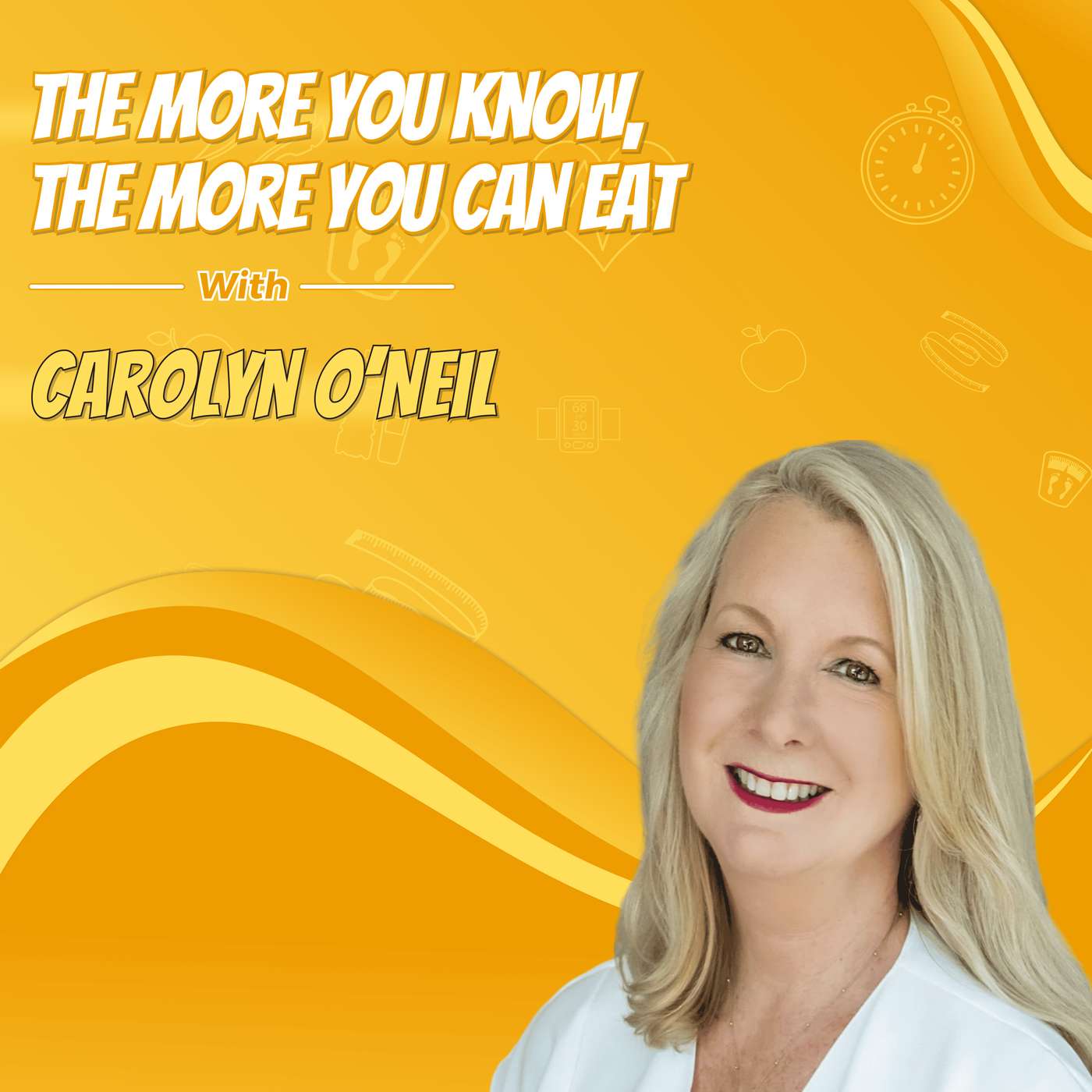
The More You Know, The More You Can Eat with Carolyn O’Neil


 Apple Podcasts
 Spotify
 PocketCasts
 Castbox
 Amazon Music
 Podchaser
 RSS Feed
 We've all felt it: you decide to eat healthier, open social media, and within minutes, you're drowning in contradictory advice. Eggs are back. Butter's healthy. Seed oils are toxic. Never eat after 7pm. Wait, only eat between noon and 6pm? By the end, you're left wondering if anyone can just tell you what to eat.
Join Holly and Jim as they sit down with award-winning food journalist and registered dietitian Carolyn O'Neil to unpack why nutrition advice feels so exhausting and contradictory. With decades spent translating nutrition science for CNN and beyond, Carolyn has made a career out of turning "pie in the sky" science into "pie on the plate" advice people can actually use. In this conversation, she shares how to separate real science from clickbait, why food doesn't have to be the enemy, and how her philosophy of "the more you know, the more you can eat" can transform your relationship with food.
Whether you're confused by conflicting headlines, navigating a GLP-1 journey, or just trying to enjoy a family celebration without guilt, this episode is packed with practical, joyful wisdom from one of the most trusted voices in nutrition communication.
Discussed in the episode
- Why the two biggest buckets of nutrition headlines are "this will kill you" and "this will cure you," and why it's often the same food
- A simple media literacy trick for telling real science from a misleading headline
- What really happened in a viral study on omega-3 supplements and brain health
- Why the "Mediterranean diet" is more romanticized than most people realize
- How to keep the joy of eating alive while on a GLP-1 medication
- The restaurant industry's surprising response to guests eating less
- A simple framework, "the three M's," for personalizing your approach to health
- Why "shop the perimeter of the store" might be terrible advice.
- Carolyn's rapid-fire answers on the most overhyped nutrition claims, misleading headlines, and her favorite food city in the world
- A practical tip for enjoying food-centered family traditions without overeating or guilt
James Hill:
Welcome to Weight Loss And, where we delve into the world of weight loss. I'm Jim Hill.
Holly Wyatt:
And I'm Holly Wyatt. We're both dedicated to helping you lose weight, keep it off, and live your best life while you're doing it.
James Hill:
Indeed, we now realize successful weight loss combines the science and art of medicine, knowing what to do and why you will do it.
Holly Wyatt:
Yes, the “And” allows us to talk about all the other stuff that makes your journey so much bigger, better, and exciting.
James Hill:
Ready for the “And” factor?
Holly Wyatt:
Let's dive in.
James Hill:
Here we go.
Holly Wyatt:
Jim, I think almost everyone listening has had this experience. Now, hang with me. You decide you're finally going to eat healthier. You're motivated. You're ready to go. Then you open up social media. Oh, eggs are back. I like eggs. Okay, okay, I'm going to get some of those. Oh, butter. Butter's healthy now. Okay, that's good. Wait, seed oils. They're toxic. Okay, okay. Never eat after 7 p.m. Man, I need to write that down. Oh, wait, this other person says only eat between noon and 6 p.m. Okay, wait, that's confusing, but okay. Avoid ultra-processed foods. What are they? Okay, I need to count my protein. Definitely see a lot of people talking about protein. And then, wait, I've got to max out my fiber? Got to count calories? By the end, you're wondering, can somebody just tell me what to eat?
James Hill:
Oh, yes, Holly. We all experienced that. And even more important that we want to focus on today, are you going to enjoy this? Because it sounds like that person wasn't really enjoying the idea of eating healthy. So somewhere along the way, it feels like we maybe started believing that if food tastes good, it probably isn't good for us. So Holly, today we have someone who's going to help us unpack this. Our guest is Carolyn O'Neil. Carolyn is an award-winning food journalist. She's a registered dietitian. That's important. But she's one of the most trusted voices at the intersection of nutrition and real-world eating. She spent decades, and I've followed her, and she's somebody that I love the stuff she's written. I've followed her for many years. She spent decades translating nutrition science into practical and enjoyable. Enjoyable, Holly. I like it.
Holly Wyatt:
I like it.
James Hill:
She's worked at CNN and across other media.
Holly Wyatt:
Wow.
James Hill:
She's had several best-selling books, The Dish on Eating Healthy and Being Fabulous, the Slim Down South Cookbook, and the host of the podcast, Watch What You Eat. Known for her refreshing philosophy, (this is going to be fun) the more you know, the more you can eat. Now, Holly, you love that one.
Holly Wyatt:
Yes.
James Hill:
Right?
Holly Wyatt:
Definitely. That's a good one.
James Hill:
She brings a balanced, joyful approach to food, health, and how we actually live our lives. She's covered food from almost every angle, science, culture. Now she tells me she's doing a lot of travel and looking at restaurants and food is celebration. She's been in the studio where a study broke and she had to explain it to millions of people in 90 seconds. And she brings a warmth and clarity to this conversation that the nutrition field desperately needs. Carolyn, welcome to Weight Loss And.
Carolyn O'Neil:
Wow, thank you so much for that beautiful introduction. You're absolutely just make my day, put wind in my sails to keep it going. I thank you so much for this conversation today. I cannot wait to get started and just see, you know, you mentioned I've been in the biz a while of nutrition communicating and nutrition news.
Carolyn O'Neil:
But the, you know, the hits just keep on coming. The hits just keep on coming.
Holly Wyatt:
Yeah. So I am so excited about having you on because there's just so much we can talk about and you've experienced, I think, this from a different angle than most of our guests that we we have on this podcast. So you've spent your career standing between what I would say nutrition science and the public. And when a new study came out, when the headlights started flying, when people were wondering, what does this actually mean? You are often the person that tried to translate it for them. How did you end up becoming that bridge between science and everyday life?
Carolyn O'Neil:
You know, your questions that you sent to me ahead of time really got me thinking. And boy, I can tell you're university-based because you really put a lot of thought into this interview. And it made me pause and think and think back because, you know, you just take it for granted. You're along for the ride. But, you know, as I analyzed what my approach was, even before CNN, I did get a master's degree in nutrition at Boston University with a specialization in communication. Now, that was very new at the time. I think University of Missouri also had that, and now Tufts is famous for it. But three things happened. Number one, making sure you know as much as possible about the topic, science of nutrition, and then learning the right way to communicate science. And at Boston University, they actually had a specialty or have a specialty in science communications. That means how do you read a study, right? Was it an animal study? Was it a controlled study? Was it a letter to the editor maybe that ended up in New England Journal of Medicine, but then everybody thinks it's a study? No, it wasn't. It was a letter to the editor that just happened to be interesting. And so studying how science is conducted, the research is conducted, always enjoying the summary at the top, you know.
Carolyn O'Neil:
And then digging in, digging in, and then realizing this study is, you know, no man is an island. This study might be a bigger part of the whole. So how does it fit in with what we already know? How does it fit in with maybe what we still don't know? So, that is what I would do when I would look at a study just to see who did it, why they do it, what they find, what were some of their summaries of like what it meant. Of course, we interviewed the researchers and then other folks to say, hey, what'd you think of this if they were happen to be in that field to hopefully get down to some kind of a kernel of advice. And for me, the advice had to be translated into, what am I putting into my grocery cart? What am I feeding my kids? What am I packing in my lunch? What am I ordering at the restaurant? Again, making it not just easy to understand the findings, but like, how does it impact me? And again, we'll talk about this a little bit. Now we've moved more into personalization. Maybe that advice isn't good for everybody. And so how do you adapt it if you happen to have high blood pressure or happen to be pregnant or whatever your health situation is?
Holly Wyatt:
Love this because Jim and I talk about taking the science and putting, I kind of call the science pie in the sky because there's a lot of themes and abstract ideas and principles, but how do you translate? We call it pie on the plate. So you've been really good at taking that science that's that pie in the sky and saying, okay, pie on the plate. What do you do with it and that's hard to do sometimes.
Carolyn O'Neil:
And I tell you what, it's hard to do when… I remember one of the first big challenges at CNN was, I think it was, oh, I started there. Oh, my gosh, I'm going to embarrass myself. I started there June the 14th, 1982. Can you imagine? Anyway, so there was a big study came out from National Cancer Institute. It was a big, giant, green book. It's what we know now about diet and health as it relates to cancer risk, okay. So then I have to take that giant book and translate that into a two-minute television segment, okay?
Holly Wyatt:
Yeah.
Carolyn O'Neil:
And you know what? I've always loved, I call it the Hallmark card of nutrition communications or science communications. You know, one little line in a Hallmark card can just reach your heart and your soul and your mind with just a sentence. I had a whole two minutes to explain things.
James Hill:
I love it. I love it. We've got so much to talk about. But one of the things that I love about your career is you haven't bought into the idea of making people afraid of food. You've spent decades helping people enjoy food. Where did this idea of food is the enemy come from? And how have you approached that whole thing?
Carolyn O'Neil:
I will tell you one thing, I can get pretty negative on food safety issues. You know what I mean? Like make sure you don't do this and you don't do that. You don't do this, you know, but the end is so you'll be healthy. I think rather than being the kind of journalist who's going to dig up the dirt on milk or dig up the dirt on like, you know, don't believe this about orange juice or dig up the dirt on like, you know, so you thought avocados were healthy. I found no use for that. I didn't think it was helpful. And maybe it's because, as you mentioned, I'm a registered dietitian. So I think we're trained to be of service to people to really navigate to see, you know, tell me, you know, I think that my readers, my listeners, consumers turn to experts and say, tell me what to eat and why. Just don't tell me too much about the why because my eyes will start to glaze over. But, and I also think the positivity, I originally studied in the School of Home Economics at Florida State University. And from the get-go, those folks who started home economics, I think, always cared about helping people find the right thing to do, for health, happiness, and, as you know, protecting their budgets and their bodies.
Holly Wyatt:
Yeah, I think, you know, we believe in this too. I think when I was younger in my career, it was kind of like, okay, we're going in as a warrior and it may be hard, but we'll get through it and you're going to lose weight. And now that doesn't work. I think it works so much better to say, can you bring that joy and fun into your life? Because it is your life and it is forever. So why do you think that so many people think enjoying food means they're doing something wrong or they have to sacrifice? Where did that come from? And why do so many influencers and people who are trying to communicate with the public use fear instead of joy?
Carolyn O'Neil:
Right. The influencer will see you now. And that, by the way, is the title. Today, one of my friends and I just love this guy, Mike Lee. He's a food futurist, and he has a newsletter out today, and it says the influencer will see you now. But back to, you know, Holly, what you were saying about the fear. First of all, again, I'm not a historian, but I've heard it mentioned, I know you all have too, over and over that, is it because of our puritanical roots, you know what I mean, in the U.S.? We're always talking about world cuisine. As Jim mentioned, I travel. I mean, is this the way they have a relationship with food in Italy? Is this the way they have a relationship with food in France? Is this the way they have a relationship with food, with beer in Scotland? I think it might just be a part of our American roots, maybe, somehow, somewhere. Just an observation. But you can't blame people because over the decades, there's been two buckets that I could identify of nutrition news specifically. And that would be, number one, the headlines that are, what you eat can kill you. And then the other headline category was, what you eat can cure you. And sometimes it was the same food.
Holly Wyatt:
Yeah, same food. Yeah.
Carolyn O'Neil:
And that is the go-to for the headlines. It's like oatmeal, you know, spread oat bran all over a big fat steak and you're going to be fine. Because people are like, “What? I know it lowers cholesterol. So I can just have an oatmeal crusted ribeye. Okay.” No, it doesn't work like that. It doesn't quite work like that. But I see where you're going with that. So, again, those, I think, were the two buckets, curing and killing. And believe me, I was a part of that locomotive at CNN, but always tried within my reporting when something came out that was like super negative to say, all right, let's think about this. What does it really mean? What can you do to incorporate this into blah, blah, blah, your lifestyle and your health goals?
James Hill:
So, Carolyn, when I go out and talk to people, I hear oftentimes, “I'm just so confused about nutrition advice because I hear one thing this week and another thing next week. I don't know who to trust.” How do you address that?
Carolyn O'Neil:
You know, there is a lot, I call it flip-flop, a lot of flip-flop going on. And on the face of it, as you know, as researchers, science is a process, science is a journey. And if you isolate one little pearl on that string of pearls, you might be confused to say, “Oh, wait a minute, I thought coffee was good for my energy and my cognitive function. Now I'm hearing caffeine is bad for my blood pressure.”
Carolyn O'Neil:
What's a latte lover to do, you know? And so I think that it is the role, the job, the responsibility of those of us who communicate science and nutrition in this case. Again, I hate to keep saying this, but put it into perspective. And just this morning, in preparation for our interview, I decided to go and say, nutrition news headlines today. To see what's out there. And are you ready for this? And this falls right into the category, Jim, of what you were talking about. A study from obviously, great people, great research at USC. That would be University of Southern California, not South Carolina, which, you know, a lot of people don't realize they have the same initials. But anyway, great people there. A study came out on omega-3s and brain health. And they specifically were using DHA supplements, and so, fish oil supplements, and they found, (get ready for a whiplash) no benefits in memory, cognitive function, or in offsetting…
James Hill:
Get rid of those supplements. Toss them.
Carolyn O'Neil:
Yeah, and Alzheimer's. But then the researchers, of course, you know, really terrific job. It was, you know, this is what matters to us. It was placebo-controlled, double-blinded. Again, this is just little cliff notes I read real quickly. And so the bottom line, they said, really, what you should be focused on is, diet and lifestyle and leaning towards all of the good stuff in the Mediterranean diet, which is more than just fish, right? It's more than just omega-3s. So again, there we have, like somebody might read this today and they just bought some omega-3 supplements and they're like, great, great.
James Hill:
I get my money back. You know, one of the problems is sometimes people want to make stuff too simple. I'll give you one example. I've worked, and Holly has too, for years with the National Weight Control Registry. And one, we found a lot of characteristics of these successful people. And one was that almost all of them ate breakfast. Well, people went out and did some studies where they just changed one thing, breakfast. And guess what? It didn't make any difference because it's not one thing. They were eating breakfast and they were exercising and they were eating well. So we want to sometimes make it too simple.
Carolyn O'Neil:
Yeah. And I think with the Mediterranean diet, a lot of people, it's very romanticized, isn't it?
James Hill:
It is. It is.
Carolyn O'Neil:
And it is. It's beautiful with the images of the blue waters of Greece and the olive branches and, you know, running in the original Olympics and, you know, all of that. And so I remember reading and reporting on a study out of Crete, and that's one of the places where people live the longest. Well, they weren't just course consuming olive oil. They were doing lots of other stuff, including up until like a really advanced age, walking up hills with their goats. And you want to get romantic about something. It's not just pouring olive oil on your salad. It's that running up a hill with goats.
James Hill:
Exactly. Exactly.
Holly Wyatt:
Yeah. So I think one thing you pointed out and is kind of this, you have this, you're responsible nutrition journalism. You have these skills to do this. But one thing Jim and I talk about now, people who eat are experts in eating. You know, it doesn't require anything but that you're kind of eating out there. So for our listeners, what's maybe a media literacy skill or how do they tell who maybe to listen to versus who has the background to be able to talk to them, who maybe is just kind of going off the top. The first thing they think about, you know, what do they do out there?
Carolyn O'Neil:
Well, another headline today, Holly in my little purview just a few moments ago, a study on sugar chemistry breakthrough, sugar, which, of course, anytime that ends up in a headline, it may as well be like a little photo of Darth Vader. Okay.
Carolyn O'Neil:
Anyway, the devil's in the details, obviously, as we know, but sugar chemistry breakthrough. So the study was, and I will get obviously back to your question, Holly, it was comparing glucose to fructose on how it impacted hunger, satiety. And then they found that the study was, oh, glucose won and fructose lost as it looked like the fructose had a very weak effect on hunger, tamping down the hunger situation and satiety. Now you read the whole thing. Okay, there you go. So I will go back and read the whole thing. But I think that when people, you ask for some advice for folks. Again, remember that that study is just one pearl in a string of studies and information. If you have the time, and I think you're worth the time, folks, read the study, even though you may not have a PhD in biology or anatomy. Read the top part, the executive summary. You don't know what all the charts and the graphs mean. Someone else might and then always at the end there'll be sort of a summary of here's what we think this means to you and then they also mention usually in a review of the literature other studies that are kind of in that same neighborhood. So if it's something that matters deeply to you, go ahead and do that
Carolyn O'Neil:
The other cool thing is with AI, hello, you take that study and you ask AI, can you translate this for me and what it means to me, and this could be talking to a registered dietician, obviously, too, if it happened to be about blood pressure or blood sugar, but even, It's fascinating to see how it'll boil it down on AI, at least put it into people speak from the science speak. And that's a pretty good job. I think doing a better job. What do you think? The AI translating?
Holly Wyatt:
Yeah, I think you have to be careful, but I think it's a tool that definitely helps people.
James Hill:
It's a tool that you should use.
Holly Wyatt:
Yes.
James Hill:
Okay, I want to put you on the spot here because our listeners now are saying, okay, what should I be eating? What is healthy eating that brings enjoyment look like from the point of view of Carolyn O'Neill?
Carolyn O'Neil:
Well, you mentioned my philosophy, and I came up with it, the more you know, the more you can eat. And that was after several years of covering this roller coaster of nutrition news while at CNN, reporting on literally, daily, we had two reports every day, plus a half hour show, can you imagine, every week, I don't know what in the world we were thinking. But anyway, the more you know, the more you can eat. And this came to me because, let's say there was a study about sushi, okay? Oh my gosh, it's got worms. Sushi has worms in it, okay? Well, you know, it can't. Why do you, then I said like, let's look into this. This is why there are sushi masters. Raw fish is going to come with an inherent risk for some of these little parasite-y things, okay, not trying to gross you out, but that is why a sushi master slices the fish on a lighted board and with a very, very sharp knife to slice, through the sushi. Did you know that? Oh my goodness. This is why gas station sushi might not be the way to go.
Carolyn O'Neil:
If you're dining at a beautiful place that cares about the quality of their fish, they got a sushi master. That's what they're looking for. Again, the more you know, the more you can eat. And sugar. Oh, I'm never going to eat sugar. I'm going to cut sugar out of my diet. How many times have we heard this from people? And so I said, you know what, sugar, the more you know, the more you can eat. Sugar is like sunshine and too much sunshine, you're going to get wrinkles, get skin cancer. Too much sugar, diabetes. But a little bit of sugar is like sunshine. It is how much you're using. And then if you're smart in the kitchen, when do you use the sugar so you're getting maximum flavor as opposed to maximum quantity? And again, agave versus honey, it's one better than the other. Nutritionally, probably not. But in the kitchen, yes, some are better for different uses. So you get more joy, you get more bang for your buck, and you're not banning it from the kingdom.
Holly Wyatt:
And I love that you're adding in the joy. So it's also about that, thinking about these things, but also thinking about the joy, which brings me to a topic that I really am excited to talk to you about. You know, we have the new GLP-1s. We talk about the GLP-1 journey and before and after GLP-1s on this show. It's a big topic. It's changed everything. We call them game-changers. What's your kind of philosophy on this? Because for a lot of people, not everybody, they go on a GLP-1, a lot of people are saying it kind of takes the joy away from eating. They don't think about food anymore. They used to really enjoy going out to eat, and maybe it's something they did with their spouse, and now they just really don't get the same enjoyment from it. Not everybody, but there's a good percentage that are kind of reporting this. What do you think about that?
Carolyn O'Neil:
Well, first of all, as you practitioners know, I think the best way to add a GLP-1 weight loss medication to your life is to make sure you have somebody helping you along the way. We've heard reports of people just, I don't want to call it overdose like some drug. But the thing is, you might be on a dose that's too, maybe higher than you need to be on, which is impacting your appetite more so than you need it to be, okay? So again, making sure that you are working with somebody who can help guide you sharing these feelings, Holly, right? Like I was talking to a friend the other day, and he said, you know, I haven't, are you ready for this? I haven't eaten in two days. And I said, what level are you, first of all, what are you taking? And what level are you on? And it was extremely high, okay? And you know, we can talk nuts and bolts here. I think he was going anywhere between five and 10 milliliters a week where you maybe he should have been on 2.5. So again, like anything, the symptoms matter, but you need to share that. So let's say you are doing the proper dose for what your goals are. I don't think that it does impact the joy of food.
Carolyn O'Neil:
It certainly impacts portion size. It impacts how much you're going to eat. And so I think to prioritize, like an action plan for GLP-1 joy, at the table would be to really prioritize the deliciousness of food. If you get filled up more quickly, don't eat something boring. I don't know. But then again, you got to think of nutrition. So you want to make sure you got the protein and, not just protein, but a whole host. As we know, it's like people seem, because they're eating less, you know, they may not have as much B12. They may not be getting magnesium, the calcium. Again, why you should be followed. A lot of times those blood tests are not done to show something is, you know, that profile. Well, I'm kind of jumping around here, but what I think is the dosing matters, the guidance matters, and if you are experiencing loss of joy, you might be on too much.
James Hill:
I think, when people start on these medications and they're extremely effective for weight loss, and you know from your work, weight loss is just so rewarding for people. But what we're talking about is being on these drugs chronically. And I wonder if the joy of food is going to become more important down the road because you aren't going to lose weight forever. Even if you stay on the drugs, you're going to reach a point where you're at a new plateau. And now I wonder if the whole joy thing might become more important. And as a nutrition community, if people are eating less, maybe what we should look at is trying to get more pleasure into the food they're eating.
Carolyn O'Neil:
Well, we already know that the restaurant and hospitality industry are pivoting and pivoting quickly to face the challenge of more and more of their guests, their customers, their diners, not eating as much as they used to, not drinking as much as they used to. And whether it's Chipotle adding to the menu something that customers were just kind of hacking on their own, a cup of chicken, you know, they're like, what do you mean you just want a cup of chicken? And then they added to the menu. But then at fine dining, I was at a beautiful restaurant here in Atlanta called Canoe. It's on the river. Fantastic food. Known for just very generous portions and deliciousness. I was absolutely impressed, shocked, and surprised when the server came over and she says, oh, by the way, and I was dining with two other friends. Don't know if anybody was on GLP-1s at all but this was something she presented to the table. “By the way, anything on the menu, if you'd like a half portion, we're there for you.”
James Hill:
Wow.
Carolyn O'Neil:
Do you remember we used to say, remember some restaurants would go like no splitting or a charge for splitting is like $5 or something. So this was, we're like, you mean the appetizer shows? “No, everything. Everything. The entrees, everything. We're happy to give you a half portion.”
James Hill:
So you are seeing some real change out there in the restaurant industry.
Carolyn O'Neil:
Yes.
James Hill:
Wow.
Holly Wyatt:
I think that's good news. I mean,have those options available and they're responding. And I think that's great news. I find it interesting that a lot of people go on GLP-1s because they don't want to have to think about what to eat their whole life, right? They've had the food noise. They've been having to log their foods. They've struggled. It's been something they've had to put some energy in their whole life. And they're like, for the first time, I go on this GLP-1. I don't think about food. The weight's coming off. And now I'm what I think we're starting to see is you're still going to have to think about food but just differently, because you're now going to have to think about how much you're eating and are you getting the nutrients. I think this joy thing, we don't understand it yet but we're calling it, Jim, what are we calling it? Anhedonia. And it's a real symptom for some people, not for everybody, so I don't want people who are thinking about going on GLP-1 to “oh my gosh I'm not going to have any joy when I eat.” Not everyone.
Carolyn O'Neil:
Or joy in anything. Joy in listening to music. Joy in watching.
James Hill:
Exactly.
Carolyn O'Neil:
Their favorite TV show, Episode 7, Are You Still Watching? You know, like, yeah.
Holly Wyatt:
Yeah.
James Hill:
Yeah. And it's not too surprising because these medications hit a part of the brain that really is involved in reward and pleasure. So I think we're understanding much more about how they work and some of the other impacts of the medication.
Carolyn O'Neil:
I would love to know more about that because what do y'all think? I mean, like again, a lot of things going on here. If somebody's eating less, drinking less, even the thirst mechanism, as we've learned, is also tamp. You have to force yourself to drink more fluids. Could some of this anhedonia be dehydration, nutrient, sub-level, whatever, nutrient deficiencies of B12? We know that impacts the way we feel. Again, the magnesium, the calcium, the vitamin D3. So my concern as a registered dietician is, as we're consuming less food while taking a GLP-1, if you're not feeling great physically, mentally, whatever, just, you know, not your usual little vim and vigor, could it be dehydration? Could it be a subtle nutrient deficiency? What do you think?
James Hill:
Absolutely. And that's why we've said many times on this podcast that every prescription should come with a prescription for a registered dietitian because it changes the way we think about nutrition. For decades, nutrition has been how do you eat and lose weight? Now it's a whole different thing. How do you eat less and maintain optimum health? So absolutely could be those things. We just don't know why.
Carolyn O'Neil:
You know, the folks who do research on seniors, on...
James Hill:
Like me.
Carolyn O'Neil:
Like me, too. But anyway, we've always known that appetite decreases and therefore that avoiding that, what was it, the tea and toast, which was have a cup of tea and a toast and they were getting nutrient. That's where we had all the, I won't mention any brand names, but the drinks to get them, like fill up the, like your two quarts low and your oil kind of a thing. Another one of the studies today that I saw. Again, this is an example of we've heard this before, and in science, we love it when things are repeated, which means we're getting closer to the truth, right? And it was protein and seniors and their needs for cognitive function, certainly muscle mass and that arena that, yes, it needs to be higher. We've already been hearing that for a while. So the message for GLP-1 users is it's not unlike that situation. We've got solutions. We have solutions for this. And it is that nutrient density, picking foods or beverages to give you a little bit more bang for your buck if your appetite's not as big as it used to be. And then look at all the companies, they're not wasting any time coming out with special products, whether it's vitamin companies coming out with their GLP-1 companion health pack with the gap nutrients that potentially you could have, or everybody shouting, we've got more protein including one of my favorites, not recommending it, but I was just shocked and surprised. We have a, I saw a vodka protein water on the market.
James Hill:
Oh, I love it.
Holly Wyatt:
Well, I've got to say, I'll just go on record and say that I would, I'm waiting and I'm actually kind of hoping because I do drink diet sodas. I'm a Coke, I'm a Coke Zero girl. No, no, I'm not, that brand isn't my brand or anything. Don't. Don't think that. But that's what, I do drink that in the afternoon. So I'm like, can't they add some protein to this? But I hadn't heard the vodka.
Carolyn O'Neil:
Well, and it's funny where the nutrition messaging is landing. I just got back from Aspen, Colorado, and I attended the Food and Wine Magazine, they're headquartered in Birmingham, Food and Wine Magazine Classic at Aspen. And of course, all of the vendors and the booths and the excitement, everybody from the champagne to the wines of France to Spain to, beer and spirits, there in the corner, their beautiful booth was, and I won't say the name of the company, but it was, Clear Protein. Clear protein to add to things. Because right now a lot of it may be like it's a pea protein or it's this. It's kind of cloudy. So this is from whey. Whey is the source of the protein. But it was interesting to see the innovation that's happening.
Holly Wyatt:
Well, that's out there. There's a lot of products. I actually…
Carolyn O'Neil:
You can mix a little of that in with your…
Holly Wyatt:
I personally love it. I love it because it makes another option for a lighter drink. So that clear protein, for me, is something that I think has been helpful. Yeah, these are the innovations that are happening. I think some of them will probably be helpful and some of them maybe not. But that one, I actually, I've jumped on. I'm using some of that. Some products have it in it.
Carolyn O'Neil:
Yeah. And then meanwhile, you know, nothing happens in a vacuum. It turns out whey protein is so popular right now, the price is going up.
James Hill:
Of course.
Carolyn O'Neil:
But I asked them, I said, oh, are you concerned about the price going up? They said, we source our way from Denmark, cows in Denmark. I'm like, oh, okay, here we go. A little Copenhagen, a little Copenhagen cows.
James Hill:
There you go.
Carolyn O'Neil:
I don't know why, but that's what they do. Anyway, I think the company was owned by Nestle. I just can't remember the brand name.
Carolyn O'Neil:
You know, one of the questions you had on the list, which I think I would love us to talk about if you don't mind, because I think it's a challenge for everybody, this good food, bad foods, okay? Because I think it's easy, right, to put these in categories. Of course, I know that we want people to go from good food bad food to good and bad meal patterns, good and bad meal planning. One day, one meal, one food is not going to make it or break it for your overall health. We've always told people, Jim, the journaling, how important. I know at the weight control registry, didn't the majority of folks who did well do journaling and monitoring of themselves? So I don't know, how do we sell this? How do we sell the sexiness of meal planning and meal patterns as opposed to good and bad?
James Hill:
Well, I would even broaden that, Carolyn, to say good and bad lifestyles. And I'll give you an example. We talked about sugar earlier. One of Holly and I's former colleague in Colorado studied people in the Tour de France road bicycle race. They were consuming sugar three or four times the recommended amounts. Zero metabolic disease. So it's not, I agree, we've got to go from single foods to diet and from diet, lifestyle. Because if you are sedentary, it's just like on the GLP-1s, you're eating less. So you have to be so careful with what you eat. Being physically active gives you a little bit more, you can have more fun with your food.
Holly Wyatt:
Well, I think it's individualizing it. Then we even take it a step further. And what you're talking about, Jim, is some people are more active than others. And that's an individualizing concept.
James Hill:
Now we're talking about precision nutrition. Now, I will say Holly and I are very involved in a big study there. It's still a hypothesis. I don't think we know exactly, but it makes sense that different people respond differently. How might this change nutrition advice?
Carolyn O'Neil:
We already see products that are out there having you enter everything about yourself, and then they give you a QR code, and then you click the QR code, and it tells you exactly which one of their products to buy. Talk about personalization, kind of like having that wardrobe stylist. Oh, are you a summer? Are you a spring? I'll tell you what colors to wear. We're there because, as you know, the discovery of the human genome and like somebody may react to a food which is high saturated fat and their cholesterol goes very high.
Holly Wyatt:
But we don't know that yet. And that's I think what you're just saying is people are out there doing it without the science.
James Hill:
We're ahead of the science.
Holly Wyatt:
Yeah, I think we're going to get there. But we're not there yet. And yet people are selling it. Take this quiz and we'll tell you exactly what to eat. And that's that's where I think it's very confusing.
Carolyn O'Neil:
Yeah. And that is, I guess, back to that, the influencer will see you now. There's always a grain of truth, isn't there? There's always a grain of truth. And then they blow it up.
Carolyn O'Neil:
But back to personalization, I think this is where self-monitoring is so important. I guess it's kind of like the three M's in a way of health. Monitoring, like, how are your lab values, what's your body weight, you know, healthfulness, that would be the monitoring. M would be medications, what medications are you on, what health challenges are you faced with or potentially going to, you know, pre-diabetes to diabetes, that kind of a thing. Medications. And then M, I'm sorry, folks, meal planning, okay? It's the three M's, it's the three M's. And hopefully if you do make it something memorable, like the three M's, you're like, oh, wait a minute, I should probably monitor, I should probably look, you mean my medications matter here? And then the meal planning. So back to personalization, let's say it's a birthday party. Let's say you really wanna go for it. I don't care if you are in South Alabama or the South of France and you really do wanna have like a great big bowl of, you think you can't have this creamy, sugary, delicious, chocolatey, whatever it is. Julia Child said, and this has always stuck with me, you know, everything in moderation, even excess, because every once in a while, you know, you can go for it.
James Hill:
I love it. I love it. That's the pleasure.
Carolyn O'Neil:
So moderation in excess, okay?
James Hill:
Your two-minute things on CNN were great. Carolyn, I don't have two minutes, So I just get my nutrition advice from TikTok in 15 seconds. What could go wrong?
Carolyn O'Neil:
Well, I think, you know, simplification is lovely until it's not.
James Hill:
Yes.
Carolyn O'Neil:
Okay. Here's my favorite example. Shop the perimeter of the store. And I'm like, that's where the bakery and the beer are. What are you talking about? There's good stuff in the middle. You got your canned beans, you got your canned tomatoes. And the other simplification thing is, oh, avoid dining out and cook at home.
James Hill:
Oh, yeah.
Carolyn O'Neil:
I don't know what they're cooking. I don't know what they're making.
James Hill:
And grow your food in your garden. You should just eat out of your own garden.
Carolyn O'Neil:
Yeah.
James Hill:
I worry about this. I worry that we're just giving people these simple messages that are wrong.
Holly Wyatt:
And I think AI is feeding into this some that it's taking the data and it's trying to simplify, which is a good thing. You want it to be as simple as it can be. But I love what you said. Not too simple. There is this middle ground, and sometimes AI takes it, comes up with the statement, people put it out there, and I'm like, oh, my goodness, no, this is not helping. It's not that simple.
Carolyn O'Neil:
And one thing folks might not know, when you're reading, whether it's print media, digital, whatever, the writer may have written the body of the copy and spent a lot of time. Somebody else has probably written a headline for the clickbait.
Holly Wyatt:
I did not know that.
James Hill:
Oh, yeah. Oh, my God.
Carolyn O'Neil:
And it is the bane of a writer's existence. And it's like, I did not say that. Okay. I did not say that.
Holly Wyatt:
Oh, interesting.
James Hill:
All right, Holly, let's do a couple of listener questions.
Holly Wyatt:
Okay, you go first. You get to pick first.
James Hill:
Okay, here's one. I love to cook, but my spouse thinks healthy eating means plain chicken and steamed broccoli. He's married to a dietician, probably. Just kidding. How do we find middle ground?
Carolyn O'Neil:
I don't blame people for saying I don't like cooking and all that, because look at some of the recipes that are out there or have been out there. And they may begin with the statement. Okay. First, with 16 large egg whites in a large copper bowl.
Carolyn O'Neil:
Okay. First of all, I have a dozen eggs. I don't have 16 egg whites. Okay. And I don't have a large copper bowl. And I don't even know why you want me to use a large copper bowl.
Carolyn O'Neil:
Okay. It gets to like recipes you know, and love and trust. I'll go back to Birmingham, Alabama again, Southern Living and everybody at Meredith. Of course, Better Homes and Gardens, that whole crowd. These are tested. They are tested not just once. They are tested three times. And they're not just testing them for taste. They're testing them to make sure they're reproducible. So it is going to be just as good as the test kitchen version. You're not going to waste your money. And even we talked about the 16 egg whites because I've written books with Southern Living. If you call for like cream cheese you're not calling for 10 ounces if the package is eight that is normally in the grocery store. So get rid of some of the frustrations of cooking and then have recipes you trust. I'm excited you talk about that chicken and the broccoli, what can i do with that. That would just be ah you know. Get it, you know, the grill pan and you've got the olive oil and then you'd sear that chicken breast and get a little bit of browning going on. Who doesn't love a little like some onion powder or garlic powder and that kind of a thing and maybe if you've got, if you happen to use wine, a little white wine like clear all the juicy bits off the bottom of the pan, then your broccoli is just perfectly steamed. But again, not boringly steamed so that you toss it maybe with some parmesan cheese.
James Hill:
I love it. It's tasty.
Carolyn O'Neil:
Take the basics you love. I like to take people from the familiar... Wait a minute. From the basic to the brilliant.
James Hill:
Yeah. So try some new things.
Holly Wyatt:
I always say, let's make it sexy. You can take a chicken breast and make it sexy.
Carolyn O'Neil:
Oh, my gosh. You know, in my book, The Dish on Eating Healthy and Being Fabulous, that I wrote with Densie Webb, we had in our chapter called The Dish on Cooking at Home, how to accessorize your breasts. And...
James Hill:
Ha, ha, ha.
Carolyn O'Neil:
And it was, again, teaching how to cook that perfect little boneless, skinless chicken breast. So it's not like a hockey puck. So it's absolutely delicious. And then different easy sauces, whether it's capers and lemon or it's barbecue sauce, you know, accessorize it different ways with the same technique. You learn just one technique.
James Hill:
All right, Holly, one more.
Holly Wyatt:
This is one people ask me all the time. So I want to hear your answer on this one. My family celebrates everything with food. We've done this our whole, my whole life. Everything is celebrated with food. How do I enjoy those traditions without feeling guilty or without overeating, without having to eat more than I want to? And is there such a thing as too much celebrating with food?
Carolyn O'Neil:
Well, I don't know. Maybe we should all move to New Orleans. It seems like it's definitely a sport there. Times have changed in New Orleans too. But back to the family spread, whether, I don't care if you're on a cruise ship or the family spread, especially when I think about like the big groaning sideboard of all these beautiful things, you know, take a look at everything first, kind of scope out the scenery, see what matters to you most, go for your favorites. You don't have to sample everything unless Aunt Millie's watching and you're not dipping into her potato salad. Okay. Maybe, hey, Haley's Comet. Okay. So that's my recommendation is, yes, it's a celebration of food, but thinking of yourself. If you're more of a dessert kind of person, maybe you skip all the cheese and crackery kind of things, the pimento cheese and this, that, the other, because you're saving yourself for like, oh, I really want a piece of that banana cream pie. And can there be too much? No, never, never. Nothing better than leftovers. And I go to a lot of parties with friends and the best friends, you know what they have in their kitchen? They have little takeaway containers. Hey, who wants some of this to take home? Who wants some of this to take home?
James Hill:
Yeah, love it.
Holly Wyatt:
I like the sample. One of the things we talk about is even like Thanksgiving, I'm doing a sample plate and you don't say I'm not going to eat as much as everybody else. Just say, I want to taste everything and I'm just going to put a little bit and I'm going to have a sample plate. And people have all of a sudden people like, oh, I want a sample plate too. So there are things you can do.
Carolyn O'Neil:
And one more thing of what I've seen changing in the marketplace of restaurants. There's a restaurant here in Atlanta I went the other night and they automatically have the to-go things, not just at the end of the meal when you feel like you're annoying them. Can I get a to-go thing? No, they're right there. The server was right there. She goes, “Oh, I noticed you didn't finish your pasta and the chicken's coming. Why don't we just box that up for you?” She did it right away.
James Hill:
Love it. Love it. All right, Holly, your favorite part, the rapid fire.
Holly Wyatt:
Rapid fire. One sentence. Don't overthink it. You don't have to explain it. It's just rapid fire. Most overhyped nutrition story.
Carolyn O'Neil:
You need more protein.
James Hill:
Oh, we could do a whole segment on this.
Holly Wyatt:
We've heard people say that before. That's so interesting. Next one. One food that deserves a public apology.
Carolyn O'Neil:
Sugar.
Holly Wyatt:
This is why I love this. This is why I love this part. Most misleading nutrition headline.
Carolyn O'Neil:
Hot dogs cause childhood brain cancer.
Holly Wyatt:
Okay, here's another one butter or olive oil.
Carolyn O'Neil:
Both.
Holly Wyatt:
I knew you were gonna say that. Most delicious food that's also incredibly healthy.
Carolyn O'Neil:
Avocado.
Holly Wyatt:
I agree. One of my favorites. One nutrition rule you'd abolish.
Carolyn O'Neil:
Shop the perimeter of the store.
Holly Wyatt:
Oh, here's a good one. Best food city in the world.
Carolyn O'Neil:
London. It's London for me.
Holly Wyatt:
Really?
Carolyn O'Neil:
It's London because they have every culture and cuisine from around the world. And their service is so fantastic. And they make you feel like you're the only person there. And it's just delicious. And that's my favorite food city.
Holly Wyatt:
Interesting. What's in your refrigerator right now that might surprise us?
Carolyn O'Neil:
I do have some moonshine marinated cherries.
Holly Wyatt:
All right.
James Hill:
I'm surprised. Color me surprised. Oh, that's great.
Carolyn O'Neil:
You just take one and you put it in, maybe a drink and that's all you need.
Holly Wyatt:
Okay.
James Hill:
All right. Our last segment is what we call the vulnerability segment. We ask a couple of questions that are more about you than your work. And I'll go first, Holly. So you're kind of like me, Carolyn, when I tell people I'm closer to the end of my career than the beginning, but you're still so active. What personally do you want to accomplish in the next few years, personally and professionally?
Carolyn O'Neil:
Well, I think I'd like to keep the conversation going on why translating the science into consumer-friendly lingo is so important. And I would like to, and I do mentor a lot of young nutrition communicators to keep the ball going, to keep it going, keep it going, because it's never going to end.
Holly Wyatt:
Yeah, that's good. Legacy there. Keep your legacy, right? By spreading it.
Carolyn O'Neil:
Is that what that means?
Holly Wyatt:
You've done this so well. You want to pass on that this is important to other people and help them be able to do it. It's a skill not many people can do. I don't know if you realize that.
Carolyn O'Neil:
And keep the comedy in it. Keep the, humanity in it. Let people fail and fall down and get up again and laugh about it and just brush yourself off. And it is some, it's okay.
Holly Wyatt:
Perfect segue into the second vulnerability question. Over the years, is there something you once believe or taught about nutrition that you've changed your mind about or maybe you were wrong about?
Carolyn O'Neil:
Well, I'm not going to blame my mom, but she does get a lot of credit. And that is the notion that we used to say, oh, that food is fattening. Oh, that's fattening. Yeah, so I don't believe that anymore. Again, it's not about foods. It's about meal patterns and lifestyle. Yeah.
James Hill:
Wow. So to close here, Carolyn, I'm going to give you a chance to talk to our listeners that are out there struggling with nutrition information, trying to manage their weight, trying to eat healthy. What's a tip you would give them.
Carolyn O'Neil:
Okay. Hey, you know, when we're going grocery shopping and whatnot and everything, things are so expensive these days. A lot of times when you're told to or you want to eat more healthfully, you end up in the produce section, right? And there's beautiful things here. They got the pre-cut stuff. They might be a little more expensive. But don't be afraid of the freezer section. I always empower people to say that foods is produce, the frozen fruits. Again, great recipes that you can find, frozen vegetables. Now, I'm not talking about necessarily, the broccoli flourettes in the cheese sauce and the extra bacon in the freezer section, although, I have been known to buy that and mix it in with a big bag of frozen broccoli flourettes to get the flavors and then the oomph of more fiber and lower the total fat and lower the total calories in that. And it makes it delicious. You're using that sauce, but you're not, you know, it's not so concentrated. So don't be afraid of the freezer section. And also know that canned beans, you don't have to do them from scratch. Canned beans are just a great product. And so many chefs I know.
Carolyn O'Neil:
I was at a beautiful Relais Chateau property out in Montana. He made a gorgeous dish called Cowboy Beans, and he used three different kinds of beans, all canned. And he said, no, it's kind of a waste of time to just cook them on your own. Why not just use, you know, the canned beans? So there you are. Okay to find these shortcuts to help you get to that checkout line, save some money, save some time, and have just as healthy and happy a result.
James Hill:
Wow, I love it. Well, Carolyn, thank you so much for joining us. I think you've reminded us that healthy eating doesn't have to be about fear or restriction. And personally, I just want to thank you for what you've done over the years. I've followed your work very, very closely. And you are one of the best at taking complex information and communicating it in a simple, actionable way. And again, I know that you've been an incredible role model for so many registered dietitians that are trying to follow in your footsteps. So thanks for being on Weight Loss And.
Carolyn O'Neil:
Thank you so much. You have just given me so much energy, inspiration to continue our legacy.
James Hill:
Keep going.
Carolyn O'Neil:
And back at you, both of you. Holly and Jim. Let's do it again. And I got Jim coming up on my podcast, Watch What You Eat with Carolyn O'Neill. Thank you.
Holly Wyatt:
We'll have you back. We have so many questions.
James Hill:
We'll definitely have you back. We got lots more to talk about. All right.
Carolyn O'Neil:
If the more you know, the more you can eat. Then we get to eat more. More. More.
James Hill:
Love it. Well, thanks, everybody. And see you next time on Weight Loss And.
Holly Wyatt:
Bye, everybody.
James Hill:
And that's a wrap for today's episode of Weight Loss And. We hope you enjoy diving into the world of weight loss with us.
Holly Wyatt:
If you want to stay connected and continue exploring the “Ands” of weight loss, be sure to follow our podcast on your favorite platform.
James Hill:
We'd also love to hear from you. Share your thoughts, questions, or topic suggestions by reaching out at weightlossand.com. Your feedback helps us tailor future episodes to your needs.
Holly Wyatt:
And remember, the journey doesn't end here. Keep applying the knowledge and strategies you've learned and embrace the power of the “And” in your own weight loss journey.