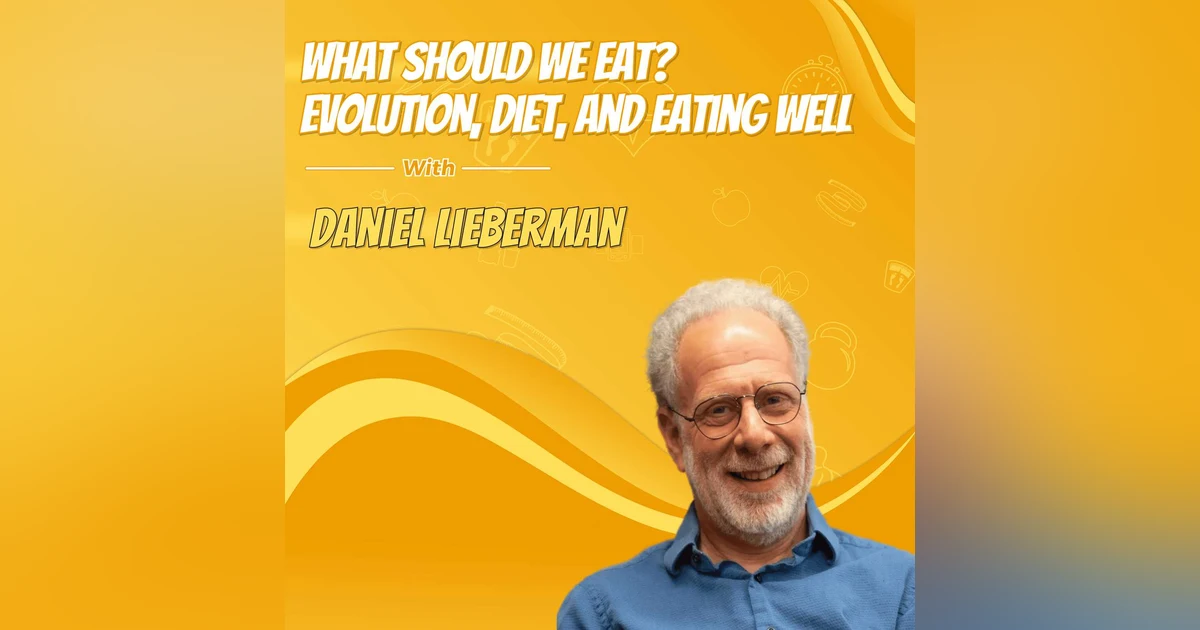
What Should We Eat? Evolution, Diet, and Eating Well with Daniel Lieberman


 Apple Podcasts
 Spotify
 PocketCasts
 Castbox
 Amazon Music
 Podchaser
 RSS Feed
 What did humans actually evolve to eat? With paleo, keto, vegan, Mediterranean, and a thousand other diets all claiming to be "the one," it's no wonder people feel whiplashed every time they walk into a grocery store. But what if the answer isn't found in the latest diet book, but in millions of years of human evolution?
Join Holly and Jim as they welcome back Harvard evolutionary biologist Dan Lieberman for a second appearance on the show. This time, Dan isn't talking exercise. He's talking food. Drawing on his new book, "Fed Up: What Evolution Reveals About Food, Diet, Health, and Eating Well," Dan explains why there's no single "evolutionary diet," why our supermarkets are a completely unprecedented environment for the human brain, and why willpower alone was never going to be enough. And because Dan doesn't just study diets, he lives them. He shares the surprisingly rough personal experiments he and his wife put themselves through in the name of research.
By the end of this episode, you'll understand exactly why eating well feels so hard in the modern world, and why that struggle has nothing to do with a lack of discipline.
Discussed on the episode:
- Why an evolutionary biologist says there's no such thing as "the" diet humans evolved to eat
- The "naturalistic fallacy" and why what our ancestors did isn't automatically what we should do
- What happened when Dan and his wife tried a raw food diet for several days (and why it ended with a bagel)
- The one natural food that's high in both sugar and fat, and what it reveals about why we crave certain foods
- How food processing quietly changed what's actually in your food, long before you ever open the package
- Why Dan calls modern ultra-processed foods "hyper-matched" to our brains
- The real reason low-carb and low-fat diets can both work, and why neither is right for everyone
- What Dan learned trying the Atkins diet as a self-described "carboholic"
- Why the Mediterranean diet keeps coming out on top, and whether that's fair to other traditional diets around the world
- His take on the vegan vs. carnivore debate, and why he wouldn't attempt one of them
- A listener's question about why the same diet can work great for one person and fail for their sibling
- Practical advice for eating well on a tight grocery budget
- The one thing Dan wants every listener to remember about their own struggles with food.
Resources mentioned:
- Dan Lieberman's book: "Fed Up: What Evolution Reveals About Food, Diet, Health, and Eating Well"
00:37 - Diets, Evolution, and Choice
01:53 - Meet Dr. Dan Lieberman
03:33 - No Single Human Diet
06:12 - Lessons From Hunter-Gatherers
10:55 - Raw Food Reality Check
16:53 - Cooking Changed Everything
20:26 - Scarcity Meets Abundance
24:16 - What Carbs Really Mean
26:28 - Mediterranean Diet Insights
29:07 - Vegan and Carnivore Limits
31:28 - So What Should We Eat?
37:42 - Why Diets Differ
39:34 - Budget-Friendly Healthy Eating
40:54 - Rapid-Fire Diet Debates
43:23 - Food Rules We Still Break
44:40 - You Are Not Failing
James Hill:
Welcome to Weight Loss And, where we delve into the world of weight loss. I'm Jim Hill.
Holly Wyatt:
And I'm Holly Wyatt. We're both dedicated to helping you lose weight, keep it off, and live your best life while you're doing it.
James Hill:
Indeed, we now realize successful weight loss combines the science and art of medicine, knowing what to do and why you will do it.
Holly Wyatt:
Yes, the “And” allows us to talk about all the other stuff that makes your journey so much bigger, better, and exciting.
James Hill:
Ready for the “And” factor?
Holly Wyatt:
Let's dive in.
James Hill:
Here we go.
Holly Wyatt:
Jim, here's a question that sounds like it should be incredibly easy to answer. What should we eat?
James Hill:
Oh.
Holly Wyatt:
We've had decades of nutrition research, thousands and thousands of diet books, and more diet advice than anyone could possibly follow. And somehow, we still don't agree.
James Hill:
Well, there's low fat, Holly. There's low carb. There's paleo, Mediterranean, vegan, intermittent fasting, count calories, don't count calories. And almost every approach has some research behind it. And everyone has people who swear by that approach.
Holly Wyatt:
Yes, people who say, this is it. This is it. So, Jim, maybe we need to ask a different question.
James Hill:
Okay, I'm for that.
Holly Wyatt:
Okay, instead of starting with the latest diet, and if it works, What if we start with, what did humans actually evolve to eat? And can understanding that help us figure out what we should eat now?
James Hill:
Ah, and to answer that question, we turn to our favorite evolutionary biologist who knows a lot about these kinds of things, Dr. Dan Lieberman. And Holly, Dan is a repeat guest. Now, we don't get many repeat guests on this show, but we have brought Dan back last time. You remember what he talked about?
Holly Wyatt:
I do, but tell us, Jim.
James Hill:
Exercise.
Holly Wyatt:
Yes.
James Hill:
This time he's talking about diet. And so Dan is professor of human evolutionary biology at Harvard, and he has a new book. The book is called “Fed Up: What Evolution Reveals About Food, Diet, Health, and Eating Well.” And there it is. And he spent his career studying human evolution, including how our bodies evolved to environments it's radically different from the ones we live in today. So if there's anyone who can tackle this question of what should you eat, it's Dan. Dan, welcome to Weight Loss And.
Daniel Lieberman:
Thank you so much. Pleasure to be back.
Holly Wyatt:
And you know what I really loved about what I'm going to love more about this conversation. I know you can tell us all about the science, but you and your wife actually lived the diets we're going to talk about. So I love that you're bringing the science and the experience to this conversation.
Daniel Lieberman:
Well, I think, you know, if you're going to study something, you should try it too. Well, I mean, within reason, of course.
Holly Wyatt:
I agree. I totally agree.
James Hill:
I wonder how you talked your wife into doing it. I know you're crazy enough to do it.
Daniel Lieberman:
Well, you know, she thought it would be fun, although she discovered it was less fun as some of the diets went on. But that's fine, you know, and she's a very funny person, so.
James Hill:
Oh, very cool. Well, let's start with the big question, Dan. Is there actually such a thing as a diet humans evolved to eat?
Daniel Lieberman:
Most emphatically, no. And I think anybody who's an evolutionary biologist sort of already knew this, but, you know, of course people have heard about the paleo diet, right? This diet that's been advertised as, you know, the diet that we evolved to eat. We can get into what's problematic with the paleo diet in a bit if you want, but the thing is that we evolved to eat anything. We are the animal world's ultimate omnivores. Thanks to being hunters and gatherers and our big brains and cooperation and tools and cooking and other kinds of food processing, humans managed to live in pretty much every environment on the planet, and survive eating the most extraordinary range of foods. And so, you know, there is no one paleo diet. There were many, many, many paleo diets. And furthermore, those diets weren't for the sake of, you know, living to be 100. People were eating so that they could survive and have as many babies as possible. That's what natural selection really cares about. And so that's the basic equation of life. I keep saying it in the book. You know, the equation of life is food in equals babies out.
Holly Wyatt:
Oh, my goodness.
James Hill:
So in a way, the ability to eat anything gave us an advantage, didn't it? In survival.
Daniel Lieberman:
Absolutely. I mean, think about the habitats that humans were able to evolve. They can live in the Arctic. They can live in jungles and rainforests and deserts and all over the planet. People managed before farming to live pretty much everywhere. And that's quite extraordinary.
James Hill:
They can live in places that don't even have whole foods.
Daniel Lieberman:
Exactly. Exactly.
Holly Wyatt:
So people, for some reason, we tend to be drawn with, well, our ancestors ate this way, this means it's the way we're supposed to eat. But just because our ancestors ate a certain way, does that mean we should eat that way today? Like, why do we think that way?
Daniel Lieberman:
Well, you know, our ancestors also didn't brush their teeth. They didn't sleep on mattresses. They didn't use refrigerators. We call that the naturalistic fallacy. The idea that if our ancestors did something, that's what you should do. Now, there is information in what we are, what our ancestors ate, because to some extent we are adapted for that. But, you know, our ancestors didn't drink coffee, but coffee is pretty damn good for you, right? We could go on.
James Hill:
One of the few vices that constantly comes out positive.
Daniel Lieberman:
Exactly. And I don't know, I might want to add chocolate to that. But the point is that there's important information in evolution, but it is not a one-to-one prescription. And we need to be sort of thoughtful about how we use evolution and integrate it with medical science.
James Hill:
I like it. You divide the book in a way before, like pre-industrial and then after processing and everything. What did you learn by studying the pre-industrial diets? You had a chance to study one of the remaining hunter-gatherer tribes, the Hadza, right? And what did you learn from all that?
Daniel Lieberman:
Well, I visited the Hadza a few times. Actually, I didn't do research on them because I was really more of a visitor a few times. But I had a chance to observe. I've gone hunting with them and watch them. I've eaten all the foods that they eat and that sort of thing. But I haven't published data on the Hadza I should. But students and colleagues of mine have done that. You know, it's a way of getting a sense. It's not, again, you know, I think people, the Hadz are one of the last peoples on the planet who are still hunter-gatherers. And there are only a few hundred of them. And they trade with other people. And they're not completely isolated. In fact, there are a fair number of anthropologists like me who come and visit them. But you get a sense of what it was like for people before farming and before supermarkets. I mean, I think one of the points I make at the very beginning of the book, which I think is really important to think about was when somebody in the Hadza land wakes up in the morning, they don't say, oh, let's, gee, you know, my wife and I, for example, we had this conversation this morning, like, what should I have for dinner today? Who's cooking dinner? And we get to decide if we can have this or we can have that or we can have pasta or we can have fish or we can have whatever. And nobody does that there, right? They get up in the morning and they're hungry, and they eat whatever they find.
Daniel Lieberman:
They don't say, gee, I think we should have kudu for dinner tonight with a little bit of side, this particular kind of tumor. If they happen to hunt a kudu, they'll have kudu. But if they don't, they won't have kudu. And that's what people like was like pretty much for everyone for millions of years. And the populations I've mostly worked with in terms of my research are farmers, subsistence farmers in Kenya and Rwanda and also in Mexico. They also don't ask what's for dinner. They eat what they grew. So when you and I walk into a supermarket and we confront something like 40,000 different kinds of foods, which is what the typical American supermarket has, we never evolved to, cope with that. We never evolved to choose our food. We evolved to get our food, and we evolved to process our food, but we never evolved to choose, especially amidst an incredible abundance of 40,000 different kinds of products, most of them manufactured to appeal to us and to be convenient and inexpensive. So there's a reason we struggle, right? Because we never evolved to do this.
James Hill:
You talk about that as an evolutionary mismatch, I think.
Daniel Lieberman:
That's correct, yeah. And food companies are right there to take advantage of that, right? They know what lights up our brains. Look, think about the foods that most human beings crave the most, right? And those are foods that are rich in both sugar and fat, right? Chocolate cake, donuts, french fries, whatever, right? They're sweet. They've got carbohydrates in it and they've got fat in it.
James Hill:
Sweet fat. That's a taste that's hard to resist.
Daniel Lieberman:
Sweet fat. Now, can you name one natural food that is high in both sugar or carbohydrates and fat? There's only one. There's only one.
James Hill:
Oh, there is one?
Daniel Lieberman:
There is one, and it's a very important one.
James Hill:
Chocolate?
Daniel Lieberman:
Oh, no, no, no. It's milk. It's the food we first started off when we were born.
James Hill:
[9:46] I didn't think of that. Yes.
Daniel Lieberman:
Milk has a lot of sugar in it, and milk has a lot of fat in it, and it lights up our brains. It's the ur food. And now, with cuisine, and especially with food processing, we've created this abundance of foods that are loaded with sugar and fat, and they drive our brains wild, and we have a hard time resisting them.
Holly Wyatt:
Yeah, I think we used to think about we're hungry, we want food, and so then that just pushed us to go out and find food. Like you said, whatever's there. Now we still have that same drive. But because the food is there and it's so easy, it's like your choice. What are we going to eat? Not if we're going to eat or it's what are we going to eat? And that same drive is there. But now the choices are so different. And what you have to do to get to the choices, right? You, could have ordered dinner from your bed, set it up to arrive.
James Hill:
You don't even have to go out to the grocery store. Now they'll bring it to you.
Daniel Lieberman:
Exactly, exactly. Just press a few buttons. So our ancestors had to know a lot to get their food. Now we need to know something about how to choose our food. And I think so that's really what I set out to do in Fed Up.
James Hill:
The industrialization and processing. You did try the raw diet. How did that go? I'm curious.
Daniel Lieberman:
I tried to pick diets that kind of went along with the history of food, right? And of course, you know, our ancestors initially didn't cook. When we separated from chimpanzees, we were eating a raw food diet. So, I thought it'd be fun to try a raw food diet. Now, the raw food dieters. Right? They're a big idea.
Daniel Lieberman:
And a lot of what I call hedgehog ideas, these big ideas that are single ideas that are supposed to solve everything. They're big ideas that cooking removes the nutrients from food, so you should never cook your food. And the thing that I already knew because my colleague Richard Wrangham here has studied this, and my colleague Rachel Carmody has done a lot of research on this, but cooking actually liberates the energy in food. It breaks down cell walls. It makes food much more digestible.
Daniel Lieberman:
You get a lot more energy from most foods if you cook them. And the raw food diet was really hard because, first of all, you realize just how many of our foods we need to cook, right? You can't eat raw beans. You can't eat raw cereals. There's a long list of things you wouldn't want to eat raw, like most meat you wouldn't want to eat raw, most shellfish, et cetera. This is super fresh. But then the other thing was that we just had to eat so much, uh, because we weren't getting that much energy from our food and we're spending so much time processing it. And I was like going to Whole Foods. I wasn't like getting the kind of stuff that hunter gatherers get. I'm getting like really high quality plants, vegetables and fruits that have been farmed and domesticated. They're low in fiber and very sweet and all that. But I was just constantly hungry. My wife, after about three days, she got depressed, actually, on the diet. And I think I described in the book, after three days, she went out and came back looking really pleased and happy and confessed that she had gone out and gotten a bagel.
Daniel Lieberman:
She was like, that was it for her. And I lasted another day on it. And that was it. I couldn't stand it.
Holly Wyatt:
So it made you, you couldn't eat enough calories. You couldn't eat enough food. You were hungry all the time. Is that what I'm hearing?
Daniel Lieberman:
Constantly. Constantly. And I was, I don't want to go into too many details for the sake of your audience, but, you know, when you eat that much food, you've got a lot of bulk going through your digestive system. And let's just say that's not very pleasant either, especially if you're, I'm a runner and having all that stuff in my gut was, let's just say unpleasant.
Holly Wyatt:
I'm going to turn it on you a little bit because a lot of the people who listen to this show have trouble, in other words, getting full. They would like to be able to eat a lot of food because they struggle with their weight and appetite regulation. So it's kind of the opposite. Maybe they would, you know, we talk about they want volume. They need more food. So could that be?
James Hill:
Low energy density.
Daniel Lieberman:
Well, sure. And it is an effective weight loss strategy. People who are on a raw food diet, they lose weight because they are getting a lot of fiber in their food. Because they have to eat so much. Now, cooking doesn't remove the fiber, right? But you just have to eat so much more food that you're getting a lot more fiber. And so, yes. But the problem is, like, as with many forms of dieting, you're hungry. And I was just hungry all the time.
Holly Wyatt:
So the calories actually change. So if you have four ounces of meat, and then you cook four ounces of meat, the calories in those four ounces change significantly?
Daniel Lieberman:
The data on meat are a little bit complicated, but the amount of it... So there's two issues.
Daniel Lieberman:
When you read the food label to something, you pick up that can or whatever, or you see that, you know, and it says how many calories are in it. That's based on what's called the Atwater Convention, right? What they simply do is they take the number of grams of protein and multiply by nine, and they take the number of grams of carbohydrate and multiply by four, and the same thing for protein, right?
Daniel Lieberman:
And so that's the amount of calories that's available in that food. But how you process that food actually determines how much your digestive system gets out of it. So famous experiments. There's a guy named Steven Secord, and I think he's in Alabama, who did these really cool experiments on rats. He'd give boa constrictors, right? So boa constrictors eat every, I don't know, every few weeks, right? And you can measure how much energy the boa constrictors are spending in digestion by how much their body temperature goes up. Just like you and me, right? When we eat, our metabolism goes up and our body temperature goes up. So it's a nice measure. and he gave them like a rat, right? A whole rat. A boa constrictor will eat a whole rat. And he measured how much energy the boa constrictor spent digesting that rat. Then he gave the same boa constrictor a few weeks later, exactly the same size rat, but this time he ground it up in a food processor. Same rat, same everything, just processed. And the boa constrictor spent way less energy digesting that rat and gained more weight because the food processing did the digestion for the boa constrictor, which of course doesn't chew its food. And so we do the same thing. When we puree our food, we get more energy from it. When we cook our food, we break down cell walls and we get more energy from it.
Daniel Lieberman:
When we cook meat, we do lose some energy because the fat drips out of it a bit, but we release some of the energy in that meat and we spend less energy digesting it.
Daniel Lieberman:
So that's one of the things about human evolution. When we started cooking our food sometime around a million years ago or maybe a little bit less, that's when things accelerated in human evolution. All of a sudden, we could eat all kinds of foods we couldn't eat before. We were less likely to get sick from our food, and we got way more energy from our food, and body sizes went up, and brains got bigger, and we got more body fat. Cooking revolutionized us so much that we are now adapted to eating cooked food, and we are maladapted to not cooking our food. It's almost impossible to eat a raw food diet unless you are a rich person living in, you know, Cambridge, Massachusetts, or Berkeley, or wherever, and you have access to Whole Foods and stuff, but if you're a hunter-gatherer or a subsistence farmer, it would be completely impossible.
James Hill:
One of the other big things that you talk about in your book that really changed things was industrialization when we started really processing our food. Talk about how that created very rapidly an evolutionary mismatch.
Daniel Lieberman:
Yeah, I mean, I think that's the biggest mismatch that ever happened in our history of eating because farming was a change, right? The hunters and gatherers, they were gathering plants and they started domesticating them. I mean, there was less variety, et cetera. But with industrialization, that's when we really started to transform our food. We started to, among other things, remove the fiber, right? So if you go to the supermarket and you buy a box of something that was made from a plant, most of the time that fiber has been removed because fiber goes rancid. If you're a food processor, you don't want people to be buying, and you're sitting on the shelf for months or years, you don't want people buying rancid breakfast cereal, right? So the fiber has been removed. In addition, food processing has added, we added sugar, we add fat, we add salt, we add all kinds of ingredients, we add emulsifiers and stabilizers, and colorants and the list goes on, right? So food processing, and we grind it up and we pulverize it. And we make it convenient and attractive and palatable.
Daniel Lieberman:
It's really with food processing that everything changes. So a simple example would be cereals, right? We've been eating cereals for thousands and thousands and thousands of years. Hunter-gatherers would gather wild barley, for example, in the Middle East long before farming. And then for thousands of years after that, early farmers would eat, when they ate cereals, which they grew, they would eat whole wheat products, right? They weren't getting white flour. And it wasn't until the 19th century, in the Industrial Revolution, when the rolling mill was invented, and they could now, instead of grinding flour, they would roll the flour and that makes it easy to separate, the endosperm, the carbohydrate part from the fiber and the germ part of it. And we got white flour and we also got polished white rice. And with that, we lost a lot of the fiber, the protein, the nutrients, et cetera, from food. We started getting diseases like beriberi. And in fact, in the 1940s during World War II, that's when they invented enriched flour. Actually, it was legally required because people were getting so many nutrient deficiencies from eating white flour that they were getting iron deficiencies and vitamin B deficiencies and so on. And now it became law to enrich the flour with the stuff that was removed.
Daniel Lieberman:
And then, of course, now we've got these ultra-processed foods where it's industrialization gone wild, right? I mean, in the book, I have fun with a DiGiorno frozen pizza. I just picked that randomly. I just walked into the supermarket and that attracted my attention. I can't remember how many ingredients and, and it's filled with stuff that you don't really actually want to eat, but it's convenient and it's cheap. And that is when really obesity rates take off. When I was born, I was born in 1964, about 10% of Americans had obesity. Now it's about 41, 42%, give or take a percentage point, something like that. So it's quadrupled in my lifetime. So what's changed in my lifetime?
Daniel Lieberman:
It's the food that we buy in the supermarket, right? That's what's changed in my lifetime.
Holly Wyatt:
So you talk about how evolution prepared us or helps us with scarcity. And now we're not in that kind of scarcity environment with these foods. Do you think that why won't evolution prepare us eventually for abundance?
Daniel Lieberman:
Well, the problem with natural selection is that it's slow and it takes a long time and you need to have genetic variation. So the ingredients of natural selection are genetic variation as well as differential reproductive success, right? And so you need to have genetic variants out there that you'd be selected for to prevent us from not eating these foods or getting sick from these foods. The problem is that most of the illnesses that we get from foods out there, so disregarding the fact that we may not have the genetic variation necessary to select, but the other problem is that most of the diseases we get from eating these foods don't hit us until we're in our 50s or 60s, after which we're already, you know, we're grandparents.
James Hill:
We've reproduced, so who cares, right?
Daniel Lieberman:
That's it. We're silent. We're silent into selection. And selection, even if it were the case, selection is still slow. It would take hundreds, if not thousands of generations. Selection is a slow process. So we cannot afford to wait for natural selection to solve this problem. This is a problem that we have to solve here and now for ourselves and for our children and our grandchildren. And waiting for evolution to solve the problem is not acceptable in my business.
James Hill:
Yeah. And willpower is probably not enough. If you look at going in grocery stores with all the different foods and the good tastes and everything, it's a little naive to think that people can just use willpower and say, I'm going to go in the supermarket and I'm just going to only get the healthy stuff and everything's going to be great.
Daniel Lieberman:
I could not agree with you more. In fact, I might even go a step further in saying that people who blame others for becoming obese or whatever because lack of willpower are really uncompassionate and don't understand how challenging it is for people. Look, I have just the same amount of problem when I go into a supermarket as everybody else. I've learned some tricks, right? So I never go when I'm hungry. I always eat before I go shopping. But I still struggle in a supermarket or when I go to a restaurant. I tell myself, I'm not going to have the dessert today. I'm not going to have the dessert. I'm no different from everybody else. We talk about mismatch, but there's another term I kind of use in the book I call, Hyper-match. I mean, these foods are hyper-matched to us. They know exactly what they're doing. If you take a food and you put a lot of fat in it, it's disgusting, right? Too much sugar, it's cloying, right? Too much salt, it's overpowered. The right combination. Yeah, but you get the right combination, the bliss point, right? Lots of fat, lots of sugar, lots of salt which on their own…
James Hill:
And there's so many products that you're going to find one that's that right combination for you that really hits it.
Daniel Lieberman:
Absolutely. And these food companies have worked very hard to find, with thousands of individuals trying these foods to hit that bliss point. There's that wonderful book, Salt Sugar Fat by Michael Moss, which is about just how they do this. Another example is Doritos, right? There are 30 flavors, I believe, in a Doritos chip, right? And there's a little garlic and there's a little salt and there's a little this and a little that and there's all these different flavors. None of them are in excess and they're all kind of balanced so that lights up our brain. You can't quite describe what's in a Dorito, but sure it is hard to eat just one. It is very hard to eat one because it's been designed to cause us to eat more and more and more. They know exactly what they're doing.
James Hill:
I want to switch gears here a little bit and talk about some of the things that you learn from your own experiences. One of the things I thought was fascinating is how you approach carbs. You tried both the low-carb diet and the high-carb diet. What did you learn, Dan, about carbs from that?
Daniel Lieberman:
Well, first of all, I love them. I mean, I'm a carboholic, just like most people, right? They're good, they're tasty, right? I love pasta. I love bread. I love cook crackers. But I've also learned that it's not the carbs themselves. I'm very happy with, with whole wheat products, right? I don't need carbs. Carbs with fiber are totally satisfying. You can have a high-carb diet that is low-glycemic, or not too high-glycemic if you avoid the processed stuff that's had all the fiber removed and all that sugar added. That's, I think, really what I learned the most, which is that there's this big fight between low-fat diets and low-carb diets.
James Hill:
Oh, my God. For decades, we've been dieting.
Daniel Lieberman:
You know beyond most people, right? And people can lose weight on both, right?
James Hill:
Totally. Totally.
Daniel Lieberman:
It depends on what they can stand, right? If you can stand a low-carb diet, all power to you, right?
James Hill:
Low-carb diets work well for weight loss, but we don't see very many people who can stick with that diet over the long term.
Holly Wyatt:
I stick with any diet, Jim.
Daniel Lieberman:
I'm one of them.
James Hill:
Well, that's true too.
Daniel Lieberman:
I'm one of them. There's no way I could survive. First of all, I'm a runner, so I love running.
James Hill:
And if you're active, though, you need carbs. I mean, carbs fuels activity.
Daniel Lieberman:
Exactly.
James Hill:
[26:01] And you need it.
Daniel Lieberman:
And furthermore, when you're active, you know, we talk about energy in and energy out. But when you're active, one of the key things about being physically active is that it decreases your sensitivity to carbs. So when I eat a cracker, if I've been exercising, my insulin levels in response to that cracker are much lower than if I've not been exercising.
James Hill:
I love it. We got the exercise in here, Holly.
Daniel Lieberman:
Exactly. So these things, they're not independent. They're all worked together.
James Hill:
I love it. So one of the other diets you gave some attention to is the Mediterranean diet. Tell us what you learned about that.
Daniel Lieberman:
Well, I mean, I kind of was raised on something like a Mediterranean diet. So it felt, it's very comfortable for me, right? Well, there's a Mediterranean Diet with a capital D that a group of researchers wrote a paper about in various journals. But there's the Mediterranean diet with a lowercase d, which is sort of what people in the Mediterranean sort of eat, which, you know, whatever. And it's that latter diet, which is kind of what I was raised on, and feels very comfortable. What's great about it is not a diet, it's a cuisine. I like tomatoes, and I like olive oil, and I like walnuts, and I like fish, and I like, you know.
James Hill:
A little red wine in there, too, maybe.
Daniel Lieberman:
Absolutely. Never hurt anybody. So, I just found it very easy.
Holly Wyatt:
Well, so it matched you. It matched what you like. But it doesn't mean it would match what everybody else likes.
Daniel Lieberman:
Right. And I think, you know, you can do, there's just, there's a bias because, you know, most of the research is done by people of European descent. But I would make a bet that a traditional Asian diet or a traditional Mesoamerican diet or traditional even African diet, the ones I've seen where I work in Kenya, would be all pretty similar, right? I mean, if you think about traditional farming diets, right? They're based on whole grains. You either have wheat or barley, rice or corn, and you mix that with a legume. Again, these are not refined, right? So you're getting the whole grain, not the white flour or the white rice, right? You combine that with a legume. Together, the grain plus the legume gives you a complete protein. You add some vegetables. You add some fruits. You add some nuts and seeds. Not too much animal foods because you can't afford it, right? If you ate all your animals, you'd be out of animals, right? So you have some dairy as a supplement. Occasionally, you have some meat or fish or whatever. And that's it. That's what people ate for thousands and thousands of years. And very, very, very few people got obese.
Daniel Lieberman:
Now, they had other problems. They had infectious diseases, but those diseases weren't caused by their diet. Those diseases were caused by poor sanitation and high population densities and living with animals, but they weren't caused by their diet. And so I think traditional farming diets, they're not a panacea. They're not a magic bullet. They're not going to prevent you from getting various diseases, but they're generally healthy. And I think that's what the literature shows. And the Mediterranean diet is just probably the best studied of all of them.
Holly Wyatt:
Yeah, I agree. The best studied. I have to ask you this because I know people want to know what happened when you went vegan. Did you try vegan?
Daniel Lieberman:
Oh, I didn't. I didn't try vegan.
Holly Wyatt:
You didn't try vegan?
Daniel Lieberman:
That was the last chapter of the book. I compared carnivore and vegan.
Holly Wyatt:
Oh, my goodness.
Daniel Lieberman:
And there was no way I was going to try the carnivore diet. And I thought, you know, I got to be even-handed. I've gone through periods of my life when I've been vegetarian. I mean, I do analyze the vegan diet, you know, which is also another thing that could never have been possible until recently. If you were a hunter-gatherer or a farmer in most parts of the world, surviving on a vegan diet, because you need vitamin B12, for example. Nobody would have even conceived of it, because that's not how people, you know, that's not their relationship to food, right? So, there's nothing, I'm not opposed to veganism. In fact, I'm not opposed to being a carnivore. But that's not how we evolved to eat. And I think most experts would agree that, you know, although you can get away with it, especially a vegan diet, it's not, you have to work at it. You have to be intentional.
James Hill:
You do. And that's why, you know, back to the Mediterranean diet, it's a little bit easier to go through life on that kind of diet. On many of these other diets, it works well when you just say, “I'm taking time out and following this diet.” Then you get real life, you travel, you have social events, you have a family, and that's when it gets harder to stick with some of these more restrictive diets.
Daniel Lieberman:
Absolutely. I think one of the lessons I learned is that most diets out there, there are so many diets out there are based on elimination. It's very tribal, right? There's all those people out there. They will never let plants pass their lips and all these people they won't let animals pass their lips and all these people they don’t want the legumes pass their lips or grains or cereals or this or that. Most of us don't really want to do that, right? There's a reason that Epicurius is famous for saying practice moderation so you can enjoy the pleasures of life in abundance, right? I'm never going to completely eliminate things, and I think that's how most people feel. And I know from your studies that that works for most people too.
James Hill:
It does. So what do you tell people when they say, Dan, what should I eat? After all this research and personal trying, what should I eat?
Daniel Lieberman:
Can I answer that question in two ways? Because on the one hand, I think, the simple answer is don't eat a crap diet. And I think most of us kind of already know that, right? As Michael Pollan famously said, eat food, mostly plants, not too much. There's not a lot of information actually in those six words, but it's kind of what most people already know. I think that the thing is that when you walk into the supermarket and you're confronted with all those nutrition facts labels, or you click on the on the New York Times or wherever you read and you're going to see today an article about eggs. And tomorrow you're going to see an article about mushrooms and the next day there's gonna be one on on beets and I don't know, whatever. And then you're going to see the latest book by Dr. So-and-so saying you should not eat this. We're constantly whiplashed, right? And I think that instead of just simply saying, what should I eat? I think we all need to educate ourselves to some extent, right? Just like in school, we learn geometry, we learn American history, we learn this, we learn that. Why is it that when we teach, for example, chemistry, like when I took chemistry in school, Why didn't they teach chemistry in relationship to food?
James Hill:
Yes.
Daniel Lieberman:
Why didn't we learn about saturated fats and unsaturated? It's not that complicated, right? It's just double bonds and single bonds, right? We don't learn that stuff. In fact, we don't even teach that to medical students very much. Why don't we teach this basic information so that we can all evaluate the information that we're constantly barraged with? And so I think that was really my argument in Fed Up, was not to tell people what they should eat, but rather to help give people the information so that they can make that decision for themselves.
James Hill:
I like that. I like that.
Daniel Lieberman:
That's the basic argument.
Holly Wyatt:
I want to follow up that because this kind of gets into what we talk about. So do you think that understanding or having the science, understanding the biology, being educated, and you were especially going into trying these diets, does it make the diet easier to follow? Because I see there's two things. You can know what to eat and then you have to eat it. And those don't necessarily kind of go hand in hand. Knowing what I should eat and the science behind it, did it impact how easy or hard the diet was for you when you actually tried to do it?
Daniel Lieberman:
I completely agree. Yeah, that's why we decided to try the diets, right? For example, I'm one of the co-authors with David Ludwig and company of the carbohydrate insulin model. I mean, I don't disagree with the model. It's true. If you eat a lot of high glycemic foods, your glucose levels are going to shoot up. Your insulin levels are going to shoot up. The glucagon insulin ratio is important, but it's one thing to know the science, and it's another thing to experience it. I tried the Atkins diet, and I couldn't stand it. I mean, I did. I did survive for two weeks on it, but it ain't for me. I need my carbs, and I'm not going down to 60 grams or 30 grams of carbs a day. I don't need to, fortunately. But if somebody else wants to do that, it's fine. But I think, Holly, you're just absolutely right. It's one thing to know the science, another thing to experience it. We all have to kind of come to some...
James Hill:
That's such an important message. It's just knowing the science doesn't mean that diet's going to work for you or you can stick with that diet.
Daniel Lieberman:
Correct.
Holly Wyatt:
I think knowing the science is important. So don't get me wrong in saying that we shouldn't be teaching that or we need that. But I don't think that alone solves the problem.
Daniel Lieberman:
Of course.
Holly Wyatt:
You can know the science and still not be able to adhere to the diet for so many different reasons.
Daniel Lieberman:
Yeah but also food is more than about just nutrition. Food is about, you know, it's like family and love and culture, taste, and money. That's why I added this sort of experiential component to the book because I didn't want to give the impression that it's all just about the calories, and the vitamins and the fiber and the this and that. It's about something more than that. It's about the history. And so I also tried to fill the book with stories about, you know, all the people who figured various things out and their experiences and, you know, because it is a rich and interesting and fun history full of extraordinary characters. I mean, I had no idea about some of these. I mean, I knew that Kellogg was kind of crazy, but I didn't know just how crazy he was. I didn't know that he gave yogurt enemas to people. I didn't know about Fletcher and his, you know, I mean, I knew about Fletcherizing.
Daniel Lieberman:
But I had no idea that he had been super obese and reading his book was insane. Or about Beaumont and his studies of the poor guy who had a hole in his stomach. And there was just so many great stories that, I think, add information, as well as sort of enjoyment to understanding why it is we eat what we eat. Look, what so many of us, myself included, I mean, part of the reason I wrote the book is that people are so confused about all the information they get. And as Francis Bacon famously said, knowledge is power. So it doesn't help. It's not deterministic. You walk in a supermarket, it doesn't solve the problem of trying to decide not reaching for that cupcakes that are there right in the front when you walk in which my supermarket always has, by the way, but it helps me turn on my slow brain, helps me think about it, helps me understand it. Doesn't always mean I make the decision that's probably best for my health, but it gives me information. And ultimately, we all have to decide for ourselves what we want to do.
James Hill:
Yeah. Good answer. Holly, we better do a couple of listener questions.
Holly Wyatt:
Yeah. And there's a couple that I think will fit really nicely with what we've been talking about. So here's one from a listener. Paleo worked great for me, but my sister tried it and got almost no results. Why can the same diet work so differently for two people?
Daniel Lieberman:
Well, that's a really important question. And I think it's a common observation, which is that, you know, humans are variable. We have different metabolisms. We have different, you know, our guts. We have different microbiomes. We have different energy levels from, you know, the kind of physical activity we do. We have different prior histories. That's one of the reasons why, I mean, if there's one word that I've gotten really irritated by when I've been reading all these diet stuff is the word optimal. Anytime a diet claims to be optimal, to me, my bs-someter goes up, right? Because there is no such thing as an optimal diet. You know, what's best for me might not be best for you or best for Jim or for somebody who's 20 or somebody who's 80 or somebody who's worried about Alzheimer's or heart disease. There is no such thing. And we all respond differently to diets. I mean, even the work on saturated fat, there are some people who can eat saturated fat and their cholesterol levels don't change very much. And others, you know, dollop of butter and up their LDL levels go. I mean, there's an enormous amount of variation. And so we should expect that. But the problem is that the diets claim to be one size fits all, and they are never one size fits all.
James Hill:
That's what sells books, Dan.
Daniel Lieberman:
Yes, that's why. I mean, if I had written a book saying, you know, if you only eat peanut butter.
James Hill:
Yeah. Oh, it would have been a bestseller.
Daniel Lieberman:
I could have a bestseller. You know, George Washington Carver was ultimately right. Only eat peanut butter. I can make a lot more money.
Holly Wyatt:
There probably is a peanut butter diet. There probably is. I would not talk.
Daniel Lieberman:
I'm sure there is.
James Hill:
All right. I'm going to move us along, Holly. I got one more here before we go to your favorite, the rapid fire. So here's one.
James Hill:
Eating Mediterranean diet or minimally processed food sounds really great, but I have a big family and a limited grocery budget. What do I do?
Daniel Lieberman:
Oh, you know, if I had the magic bullet answer to that one, I would. I mean, it's hard. I mean, processed food is less expensive than unprocessed, more wholesome food. That is a serious problem. So I think... You've got to be kind of canny about it. So I've been reading some articles about it. So there are some vegetables, for example, that are pretty cheap, right? Like cabbage. Cabbage is never going to cost you a lot of money, right? And you can do all kinds of fun things with cabbage. I could go on, right? So, there are foods out there that are healthy and whatever that aren't super expensive, but you've got to work harder at it, and there's just no way around it.
James Hill:
See, that's the idea, that you have to take time and cook them and prepare them when, you know, you've got a family of six, you go through the drive-thru and everybody's happy and it's inexpensive, right? Versus to do all this and go home and spend an hour after working on that.
Holly Wyatt:
I've got to make cabbage taste good. I've got to make cabbage taste good for my kids.
Daniel Lieberman:
Yeah, exactly. I mean, but it's hard. It's very hard. And that's the problem today. And if I had a magic bullet answer, my gosh, I would publish that too, but I don't.
James Hill:
That's the next book. Okay, Holly, Rapid Fire.
Holly Wyatt:
All right. Rapid fire.
James Hill:
Hit Dan with them.
Holly Wyatt:
Yeah. There's rules to this. So, okay. So these are fast, short answers. Don't overthink them. You're going to want to explain. I let you have one chance to explain on one question and then I cut you off because we just want quick answers. All right. There's 10 of them. Are you ready?
Daniel Lieberman:
Shoot.
Holly Wyatt:
All right. Carbs. Friend or foe?
Daniel Lieberman:
I would say low glycemic cards are friend.
Holly Wyatt:
Okay, I'll let that pass. That was good in terms of the the shortness of it. You can say whatever you want. Number two: paleo, useful idea or evolutionary fiction?
Daniel Lieberman:
It's in between. It's got a germ of truth that's been twisted to be something that's an over-simple kind of diet.
Holly Wyatt:
Okay. Ultra-processed food, biggest problem in the modern diet, yes or no?
Daniel Lieberman:
I would say yes.
Holly Wyatt:
Okay. Intermittent fasting, biologically special or mostly another way to eat less?
Daniel Lieberman:
You know, we're still trying to learn about the intermittent fasting. It's probably not a magic bullet weight loss diet, but there might be some benefits to it.
James Hill:
For some people. We agree.
Daniel Lieberman:
Yeah.
Holly Wyatt:
Sugar addiction, real or overstated?
Daniel Lieberman:
Real.
Holly Wyatt:
Mediterranean diet, deserving of the hype?
Daniel Lieberman:
Yeah.
Holly Wyatt:
Calorie counting, useful or unnecessary?
Daniel Lieberman:
For most people, I think unnecessary because you don't actually know how many calories you're getting.
Holly Wyatt:
Okay. One modern food our ancestors would find completely baffling.
Daniel Lieberman:
Actually, I have it right here on my desk. This one. Soylent. One, this is like a milkshake, which has all the nutrients you actually need. So you can live your entire life only drinking these things.
Holly Wyatt:
Okay.
Daniel Lieberman:
Imagine that.
Holly Wyatt:
Imagine that. All right. Best diet you tried.
Daniel Lieberman:
I'm going to have to go back to Mediterranean there, I think. But I like DASH a lot. DASH was good.
Holly Wyatt:
Okay.
James Hill:
DASH was good.
Holly Wyatt:
Last question. Worst diet you tried?
Daniel Lieberman:
Oh, easy. Raw. And the second worst was my trying to subsist on Soylent.
James Hill:
Okay, Holly, let's do a couple of vulnerability questions. We can't let him off very easy.
Holly Wyatt:
Okay.
James Hill:
So, Dan, after writing this book, doing all these diets, in the long run, have you changed what you and your wife eat?
Daniel Lieberman:
Yeah, slightly. I mean, I'm much more careful about additives to food. I now really look at labels. If I see emulsifiers in something, I put it back on the shelf. If I see maltodextrin on something, I put it back on the shelf. I'm much more tuned to the crap that's added to food. Pardon my French there.
James Hill:
Okay.
Holly Wyatt:
s there something you know intellectually about food, about your health, that you still struggle to do yourself? You know it, but, you know.
Daniel Lieberman:
The list is very long. I'm no different from everyone else. I love cake and I have struggled with sweets and desserts. And absolutely, yeah, I'm a normal human being.
James Hill:
All right, Holly, ask the closing question.
Holly Wyatt:
All right. So we always allow our guests, I guess, one final question.
Holly Wyatt:
After studying human evolution and the diets and trying many of them yourself, if someone was listening and you want them to remember only one thing, what do you want it to be?
Daniel Lieberman:
That if you struggle with trying to figure out what to eat or struggle with dieting, you're completely normal.
James Hill:
Oh, I like that.
Daniel Lieberman:
We never evolved to choose our food from amidst all this abundance, and we never evolved to lose weight. And so it is fundamentally challenging and difficult. And if you feel that way, you are completely normal. You shouldn't feel bad about yourself.
James Hill:
You're not a failure.
Daniel Lieberman:
Not a failure. You're a normal human being.
James Hill:
All right, Holly. I knew we weren't going to get a clear answer to what you should eat, but we got a good answer. It just wasn't one diet. But we knew going in, it wasn't going to be one diet. But I think evolution does help us explain why eating in the modern world can be so difficult. It's tough. And it's tough when you go in the grocery store with all those options, to figure out what to eat and to eat a diet that maximizes health and helps you with your weight. So, Dan, we so appreciate you spending time with us. We've hit you on exercise. I agree with almost everything you said. Diet, you've helped us understand why there's no best diet, and you've given people some indication of why it's hard to try to eat healthy in the modern world. So thanks, and thanks for writing the book. It's called Fed Up. So take a look. It's a good read, and I think you will enjoy it.
Daniel Lieberman:
Thank you. It's a pleasure.
Holly Wyatt:
Thanks for being on the program.
James Hill:
So we'll see you next time on Weight Loss And.
Holly Wyatt:
Bye, everybody.
James Hill:
And that's a wrap for today's episode of Weight Loss And. We hope you enjoy diving into the world of weight loss with us.
Holly Wyatt:
If you want to stay connected and continue exploring the “Ands” of weight loss, be sure to follow our podcast on your favorite platform.
James Hill:
We'd also love to hear from you. Share your thoughts, questions, or topic suggestions by reaching out at weightlossand.com. Your feedback helps us tailor future episodes to your needs.
Holly Wyatt:
And remember, the journey doesn't end here. Keep applying the knowledge and strategies you've learned and embrace the power of the “And” in your own weight loss journey.