What Does Your Pharmacist Want You to Know About Weight Loss Medications?

 Apple Podcasts
 Spotify
 PocketCasts
 Castbox
 Amazon Music
 Podchaser
 RSS Feed
 Your friend just started semaglutide. She got it online; it's "compounded," it has B12 in it, and it's only $199 a month. Sounds like a great deal, right? But what exactly is in that vial, who made it, and how much are you supposed to take? More and more people are facing these questions every day, and most of us don't know how to answer them.
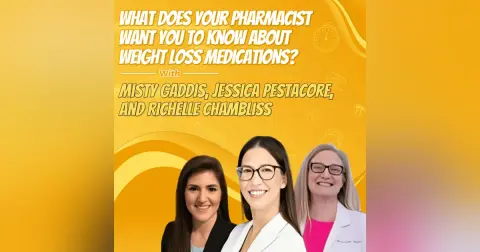
Join Holly and Jim as they welcome not one, not two, but three guests for the very first time: Misty Gaddis, pharmacy manager of medication compounding safety; Jessica Pescatore, clinical director of the Alabama Poison Information Center; and Richelle Chambliss, a clinical pharmacist who supports UAB's weight management clinics. Together, they pull back the curtain on compounded GLP-1s and share what your pharmacist wants you to know about weight loss medications, from dosing and side effects to insurance, access, and stopping and restarting. You'll come away with practical questions to ask and red flags to watch for before you inject anything.
Discussed on the episode:
- Why "compounded" doesn't mean "generic," and the common misconception that could put you at risk
- The real reason B12 shows up in so many online semaglutide products (and whether it's doing anything for your weight loss)
- What the Poison Center hears when dosing goes wrong, and why compounded products create a whole new level of risk
- The surprising truth about why the cheapest option may not be the cheapest for long
- A tempting shortcut to save money that pharmacists urge you not to take
- Why the "best" dose may not be the highest one
- What can happen when you stop and restart your medication on your own
- The red flags that should make you pause before taking anything you've ordered online
- The underrated ways your pharmacist can help you succeed, and when to call them
- A question Holly and Jim have never asked in decades of weight loss work, and why it's now on the table
00:37 - Compounded GLP-1 Questions
03:27 - What Compounding Really Means
09:52 - Dosing Errors and Safety Risks
16:44 - Poison Center Calls Increase
23:21 - Pharmacists as Patient Guides
28:33 - Stopping, Restarting, and Dosing
30:51 - Red Flags to Watch For
33:57 - Rapid Fire Takeaways
38:11 - Real-World Lessons Learned
41:33 - Why Pharmacists Matter
James Hill:
Welcome to Weight Loss And, where we delve into the world of weight loss. I'm Jim Hill.
Holly Wyatt:
And I'm Holly Wyatt. We're both dedicated to helping you lose weight, keep it off, and live your best life while you're doing it.
James Hill:
Indeed, we now realize successful weight loss combines the science and art of medicine, knowing what to do and why you will do it.
Holly Wyatt:
Yes, the “And” allows us to talk about all the other stuff that makes your journey so much bigger, better, and exciting.
James Hill:
Ready for the “And” factor?
Holly Wyatt:
Let's dive in.
James Hill:
Here we go.
Holly Wyatt:
All right, Jim, I got another question for you.
James Hill:
Oh, no.
Holly Wyatt:
Your friends tell you that they're taking semaglutide.
James Hill:
Okay.
Holly Wyatt:
[0:45] You ask where did they get it from, and they say, “I got it online. It's compounded. It has B12 in it. And it's only $199 a month.” What do you say?
James Hill:
I'd have a lot of questions, Holly.
Holly Wyatt:
Me too. Starting with what exactly are you taking?
James Hill:
And how do you know what's in it?
Holly Wyatt:
Yeah, that's the big one. Is compounded semaglutide the same thing as Wegovy? I think a lot of people think maybe it's just the generic version of Wegovy, just unbranded Wegovy. What's the B12 doing in there? That's one question. Who made it? How do you know it's legitimate? And here's the thing, Jim. I don't know that most of us know how to answer those questions.
James Hill:
And those aren't just obscure questions anymore, Holly.
Holly Wyatt:
Not at all. They're questions people taking these medications are facing every day.
James Hill:
So who does know how to answer these questions?
Holly Wyatt:
Well, that's why we are doing this episode. And we have three pharmacists with us today. And once we started putting this episode together, we realized compounding is only the beginning.
James Hill:
Because they're also dealing with dosing, side effects, insurance, access, stopping and restarting. Wow.
Holly Wyatt:
Yeah, all the stuff that happens when medications leave the kind of controlled clinical trial and then enter what I like to say real people's lives.
James Hill:
So today we're asking, what does your pharmacist want you to know about weight loss medications?
Holly Wyatt:
And yes, we've got three pharmacists today who see these medications from three different angles.
James Hill:
So Holly, many times we've had one guest. We even had one podcast where we had two guests.
Holly Wyatt:
But never three.
James Hill:
So this is the first one with three guests.
Holly Wyatt:
It needed three. That just tells you.
James Hill:
We needed three to solve this problem.
Holly Wyatt:
Yes, yes.
James Hill:
So let me introduce our three guests. First of all, Misty Gaddis. She's pharmacy manager of medication compounding safety. She's going to talk about things related to compounding. Jessica Pescatore is the clinical director of the Alabama Poison Information Center, and this is going to be important as we look at some of the problems that come up. And finally, Richelle Chambliss. She's a clinical pharmacist who supports UAB's weight management clinics. So she works with insurance coverage, et cetera. So Holly, we've got a fabulous lineup today and we're really going to get some of these questions actually answered.
Holly Wyatt:
Yeah. And you can see now why we wanted all three of you here.
Holly Wyatt:
So welcome to Weight Loss And...
James Hill:
Okay, Misty, I'm going to start with you. What does compounding actually mean?
Misty Gaddis:
Compounding is basically where you are combining, mixing, diluting, or otherwise altering, a drug substance or a bulk drug substance to, get it into the form that a patient can use when a commercially manufactured dosage form is not available in the format that the patient needs.
James Hill:
Okay.
Holly Wyatt:
Okay. So it's something that is not currently available. I think a lot of people think of when they're getting these compounded GLP-1s, that it's generic drug, unbranded. Is that a true way to think about it or not?
Misty Gaddis:
No. So a compounded medication is not, by definition, a generic drug. So compounded drugs are actually regulated, but they are distinct from FDA-approved medications. And so kind of taking your Wegovy example for your patient, your fictitious patient we're talking about.
Misty Gaddis:
So Wegovy is a patented FDA-approved drug. Generic versions of brand name drugs are also FDA approved. So generally speaking, when a patent expires or is just about to expire, manufacturers can begin developing and applying for an FDA approval of a generic drug. And so that will be, I guess, what happens when Wegovy loses its patent. But for compounding, there are regulations involved. Like I said, it's not truly an FDA-approved product, but you do have regulations that are involved to ensure that a safe preparation is being made for the patient. Also, federal regulations stipulate you can't create a copy of a patented product. The tricky part with the semaglutide is that the FDA temporarily allowed compounding of semaglutide beginning in 2022, I think, due to the extreme drug shortages, which was kind of an unusual move for the FDA, I feel like. But now that that shortage has resolved and those brand name products are readily available, pharmacies or compounding pharmacies no longer have a legal basis for compounding copies.
James Hill:
Interesting. So, Misty, talk to our listeners who may be using or thinking of using compounded medications. What's the pros, cons, any watchouts that you would sort of point out to them?
Misty Gaddis:
I definitely think that there are therapeutic reasons for using a compounded medication. And I think that patients should always have conversations with their doctors about the medications that they are taking, what is being prescribed, how they are supposed to be taking it, how they're going to get it. And I definitely think first and foremost, that conversation with their doctor has to happen first so that they know what they're getting and they understand why they're using it. For compounded medications, I think it's important for patients to use a licensed pharmacy. And so for Alabama, pharmacies have to be licensed by the Alabama State Board of Pharmacy. So you can either ask to see their license or you can go to the Board of Pharmacy's website and look that up. I also think it's important to ask the pharmacy what compounding process they use and what type of standards they are following. Are they held to good manufacturing practices by the FDA because of their license type? Or are they following the United States Pharmacopeia Standards for Sterile Preparations?
Misty Gaddis:
Ask what kind of ingredients they're using for their compounding process, where what type of drugs or peptides or bulk substances are being used. If it's a peptide that's being compounded, is it something that's on the FDA's bulk substance list or not? I think that there is a lot of safety risks involved with using research grade or gray market peptides. They're not FDA approved. They haven't gone through the same rigorous safety trials. You really aren't sure what you're getting. There could be other ingredients in the vial that could cause some health problems.
James Hill:
That's important.
Holly Wyatt:
We're seeing a lot of that too, just the research peptides out there. Everybody's taking peptides and I'm always like, wow, those have not been studied. If they're so powerful that they're creating muscle growth and this and that, it could create a lot of other stuff too that we don't know about. And so that always is a red flag. But I still am confused. The semaglutide isn't, for instance, on the shortage list. But yet these compounding pharmacies are making the drug. How can they do that? And is that where that B12 comes in? I get confused there.
Misty Gaddis:
I do think that there has been some recent pushback from the FDA. As I mentioned, we're still kind of close to that time where the FDA did kind of temporarily allow that. They are starting to enforce those rules and regulations a little bit more strictly. Additionally, a lot of state boards of pharmacies, as well as medical boards, have issued notices and put their health care professionals in their states on alert that they are not to prescribe or compound or administer non-FDA approved drugs because of the safety risks.
James Hill:
Okay, that's really important. Jess, are you seeing any problems related to these issues?
Jessica Pescatore:
We are, particularly because compounded products really create an increased opportunity for a dosing error to occur. So, just a few years ago, actually, our Poison Center published our experience with GLP-1 exposures. And while the majority of the calls we received since that time have continued to be related to medication errors, historically, we were seeing most of those errors occur really with the first dose and oftentimes related to, perhaps a perceived problem with an injection pen or a dosing pen. So that said, most of our calls were simple, you know, double dose errors, maybe a dose too soon type error, but generally falling within a reasonable therapeutic range. And with the compounded products, patients are really having to interpret very complex concentrations. They're having to measure the dose out themselves. They're often using units of measurement that may not necessarily be intuitive. And so we're really seeing almost a different level of dosing error.
James Hill:
Interesting.
Holly Wyatt:
I know. I've had, you know, friends, basically, that are not my patients, but friends saying, Oh, I got this online and how much should I take?” And I look, I'm like, “I don't know. I can't tell. It's not what we're used to.” And that's a scary thing for me.
Jessica Pescatore:
It is. And Holly, I'll kind of add to that. It's scary for us, too, at the Poison Center because we get so many calls about medications commonly. We get very familiar with commercially available products, standard concentrations, etc. And actually, for us, our calls have really become a little bit more focused on really digging and trying to walk the patient through, you know, send us a photo of your vial or trying to go to the website that they may have ordered from to even have a place to start to really risk assess and triage that exposure.
James Hill:
Wow. So, Richelle, I want to bring you in. You work on helping people get reimbursement for the meds and so forth. How does the compounding versus the pharmacy versions, how does that impact what you do?
Richelle Chambliss:
Well, we get a lot of questions from patients, I would say, on, so maybe their medication's not covered by their insurance. So the cash pricing is, you know, it starts out kind of low for some of these, like $199, maybe similar to what they would see online. But it's going to go up as the dose goes up. So they're asking, “Well, can I just stay on this? Can I start on the, you know, the brand product? And then can I just change to the compounded product as it gets more expensive?” And my answer to them is, “I really can't give you a straightforward answer.” Because compounding pharmacies, yeah, Misty talked a lot about how they're regulated and they have to be licensed. But at the end of the day, the products that come from compounded pharmacies, they don't have to go through those same approvals to prove bioavailability like a generic would. So I really can't tell you if you're getting the same dose from a compounded pharmacy as you are if you're getting the commercially available product.
James Hill:
Wow. Very interesting. A little bit scary, given how easy it is for people to get these on the internet. There was a study showing a lot of people can get these within hours, certainly within the same day. And as you said, some of them are pre-packaged. Some of them, you just get a vial and you're on your own. It's a wild west out there.
Holly Wyatt:
One thing I want to go back to, because I want to make sure, this is a question I have. We see a lot of them adding B12 or adding something. Why are they doing that? Is that part of the loophole or part of, I don't want to call it a loophole, but part of the “if I add something to it, then I can make it?” Or is there something else going on?
Richelle Chambliss:
That's exactly it. Honestly, it's part of the loophole. So semaglutide with B12 is not a commercially available product. Therefore, for these compounding pharmacies can put both of those in the same file or the same syringe, and they consider it a new product now because that's not something that's on the market.
Holly Wyatt:
Yeah.
James Hill:
You know, interestingly, I know someone that was taking it from compounded with B12 and went to a physician or B12 levels were off the charts way, way too high. So there could potentially be a downside of that.
Richelle Chambliss:
Yeah, I think it's a big concern.
Holly Wyatt:
Yeah, definitely. Depending on what they're putting with it, especially. We've talked about this, you know, the data behind B12 being that helpful in terms of weight loss. Jim, what would you say?
James Hill:
There's no data. There's no evidence it helps.
Holly Wyatt:
I always say if you're deficient in B12, then it may help you to have, you know, to be replaced, but not in general. So this is something they're adding that isn't necessarily helping with the weight loss.
James Hill:
Right. So I want to raise a question for all three of you. Oftentimes, people taking these medications don't see a real role for the pharmacist. They go to their physician, they get it. I want you guys to tell our listeners what the pharmacist can do, how they might be able to relate to a pharmacist in a way that maybe helps their journey.
Misty Gaddis:
Well, I definitely think that one thing that the pharmacist can help with is looking at their overall profile. What are all of the medications that they are taking?
James Hill:
Yes.
Misty Gaddis:
Is this compounded product going to interact with any of the other medications that they are already taking? Could they experience any adverse side effects from them? I do think that there are a lot of things the pharmacist can counsel that patient on when they come in.
James Hill:
That's a great point.
Richelle Chambliss:
I completely agree. Just the first step is definitely an interaction check. Is this safe for this patient to take? And then your pharmacist can provide you a lot of counseling as far as what you should expect with side effects. A provider may have mentioned them briefly, but pharmacists can really dive into those and let you know how you can manage them, how you can prevent them, and then how to administer the drug.
Holly Wyatt:
As a physician, I call the pharmacist because y'all know so much more about interactions and so much more than I do. So I love that you said this, that patients need to understand the resource there and just how much information you really have that can be so helpful.
James Hill:
So that's a strong message. The pharmacist is a resource that most people probably aren't taking advantage of. Talk to your pharmacist. It sounds like you guys are ready to help and answer these questions and provide guidance.
Richelle Chambliss:
Definitely.
Holly Wyatt:
Yeah. Jim, let's move to the next section. I want to ask Jessica, what happens when these medications aren't used as intended? And are you seeing that?
Jessica Pescatore:
We are. A typical call related to a GLP-1 that's being received by the Alabama Poison Center, oftentimes it's coming from the patient themselves. So typically someone will realize they've made an error, you know, usually taking a higher dose than intended. But again, sometimes it may be a dose taken too soon or even the occasional accidental administration to another household member who may also be on an injectable medication and things kind of got mixed up.
Holly Wyatt:
Mixed up.
Jessica Pescatore:
Yes. And so our first job at the Poison Center is really to help kind of reconstruct the exposure. So we want to know what product they took, the concentration, how much they were supposed to take, how much they actually administered, when they took it. And then, of course, we are very much interested in any symptoms they may be experiencing at that time, their overall medical history, and any other medications they are on that may be relating or contributing to that exposure. And really from there, our job is to kind of determine, is this a patient we can safely monitor at home with close monitoring and follow-up calls actually through the poison center? And that's an additional service we often provide to the public and the communities we serve. Or whether this patient really requires medical evaluation.
Jessica Pescatore:
Are those symptoms to a degree where perhaps we are concerned for dehydration or some electrolyte disturbances where seeking medical attention would be warranted. Now, the other side of that coin is we also receive calls from healthcare providers who are actually caring for patients who have been exposed to a GLP-1. Now, in these instances, this may have occurred from medication error and a patient is seeking attention because of the symptoms they're experiencing, or it may be related to a more intentional exposure, such as a self-harm attempt. Again, these calls, patients are typically already experiencing symptoms. So, our role at the Poison Center is to help provide supportive care recommendations and kind of help that care team with overall disposition decisions.
Holly Wyatt:
Yeah. I know we're seeing, and I do not recommend this, but we are seeing people sharing prescriptions of these drugs because of the cost. And one person gets the vial and they share it with a couple other people and their friends or whatever. Annie, have you been seeing, how have you been seeing that? Has that kind of come through the hotline?
Jessica Pescatore:
We have. Yes, we have. And it's exactly what you just described. You know, individuals who may not have access or have seen a loved one or a friend or someone within their close circle have amazing results. And so they think, “Well, they handled it and tolerated it well. I should just go ahead and try it myself.” And I think that's a little bit of the scary part of how much GLP-1s have really normalized kind of our social and cultural, perception that if something is available online or is heavily discussed via community platforms or social media platforms, that it's inherently safe and it's inherently okay for me to try with limited medical oversight. But these are still medications with true pharmacologic actions and should be respected as such.
Holly Wyatt:
Well, people are ending up in the hospital because of these drugs. I mean, they're medications. They have side effects. And that's really where you need that oversight. It's not something you could just buy and give yourself. People do have serious side effects from this.
Jessica Pescatore:
Absolutely.
James Hill:
But Holly, you know that these medications aren't simple. It's not as simple as taking a pill or giving a shot. There's escalating dosage. There's managing side effects. And when you take the physician out of the equation, which you're doing oftentimes in the online, it seems to me you're asking for trouble doing that.
Holly Wyatt:
And it doesn't necessarily, they don't know how to maximize their success either. So you're taking a drug that has some inherent risk, every drug does, and you're not even then getting potentially the maximal benefit from the drug. That upsets me, too.
James Hill:
You guys, this idea that, you know, there are a whole bunch of new medications for weight loss that are likely going to be coming out that produce even more weight loss. There's one probably that will be approved that produces an average of 30 percent weight loss. So we actually said for the first time, we're asking the question of, is there too much weight loss? Can there be too much weight loss? So I think in the future, you guys are going to see some of these issues. Not everybody needs to lose 30% of their weight, and yet it's this idea of more weight loss, more weight loss. So we talked about how it's changed the questions we're asking about efficacy of weight loss.
Misty Gaddis:
Jim, you're kind of hinting at a very important point with the follow-up with the physician when you're taking medications. And if someone is obtaining peptides from questionable or possibly illegitimate legitimate source, they may not have that relationship with their provider to follow up to make sure that they are getting the perceived benefits, and that those benefits are outweighing the risks. Is there a time that they should stop taking a medication?
James Hill:
Yeah. Holly and I've been doing this for decades and we've never asked that question before. We've never ask, is there too much weight loss? Rarely. But these medications have just really changed the game for weight management. So back to Holly's friend. So she comes to you. She says, “I went online. I got compounded semaglutide with B12. I pay $199 a month. It's delivered right to my door. Am I okay to go ahead and start taking the first dose?” What would you want to know?
Richelle Chambliss:
I would want to know what the vial looks like, what's in the vial? What's the concentration supposed to be? How much did they tell you to take? Did they send syringes with it or needles? Do you know how to approach this medication? What provider prescribed this? What did they tell you to expect? I would have so many questions.
James Hill:
And that's why they should come to you to ask those questions or to answer them. Yeah.
Holly Wyatt:
Let's be really specific. Maybe we can help our listeners. When should they be talking to their pharmacist?
Misty Gaddis:
I think they should have the conversation with their pharmacist before the medication is filled. Once it's prescribed by the physician, then they need to talk to their pharmacist about it before they actually go through the process of compounding it or filling it, and make sure that they have received all the information that they can about the product and if it's going to work for them, and not have any drug interactions.
Holly Wyatt:
Yeah. Richelle, I'm going to ask you this one because I know you're kind of with the patients a lot or hear a lot from the patients. I mean, doctors are kind of being taken out of the picture. They're online. I mean, yes, there's technically a doctor, but they may or may not even see them. And I think pharmacists are kind of being taken out of the picture because it can be delivered to their door. So what are your thoughts on that?
Richelle Chambliss:
Well, when it's a compounded product, like you said, it's these online visits. You don't really know where that doctor-patient relationship is. And I would question if there's even a pharmacist-patient relationship in those scenarios. So is this an actual licensed pharmacy that you can speak to a pharmacist and get some counseling information? I think a lot of times the answer is no for those pharmacies or companies who are on social media, kind of how Jess pointed out. I don't know that there's really a relationship with any health care provider there versus when you're seeing your weight loss physician and they give you the options, they prescribe a true medication, send it to the pharmacy. You know that all of those relationships are present. And I think the risk for patient safety concerns are a lot lower in that case. While these medications, they are truly medications, they carry risks. So you really need oversight and you need help from a healthcare provider to understand what those risks are. And I just feel like it's almost completely taken out of the equation for these online pharmacies.
Holly Wyatt:
I think convenience and cost have really driven patients to be using this new way of getting medications without any help. And the sad thing is what Jim talked about is the medication itself is not the whole treatment. It's just a part of the treatment. And you can maximize your treatment and make sure you're losing fat and not muscle and be thinking about long. There's so many things and then minimize side effects or minimize the potential for having some unwanted things happen. It's just an interesting time that I understand why we're here, but I'm just not sure we're going in the right direction.
Richelle Chambliss:
So you say for the convenience part of it, having it delivered, there are a lot of pharmacies that offer delivery of the commercially available products. So you can talk to your provider or you can even research if there are pharmacies available, but your provider may already know one that they can send it to if the whole issue is going to pick it up every month. Or even there are pharmacies that could help with access, help with getting them approved on their insurance if that's a possibility with their plan. So there are things that traditional pharmacies can do, and it may actually end up being cheaper through a traditional pharmacy.
Misty Gaddis:
I did just want to add that there are some resources available, something that your listeners might be interested in, resources to kind of help check for online pharmacy safety. So if someone is truly, you know, that's the path that they want to go down is to use an online pharmacy, the FDA does have their BeSafeRx, online educational resources so that the patients can use those resources to determine how to safely get them online. Also, the National Association of Boards of Pharmacy has their safe pharmacy check online. You can actually plug in a website URL to determine if that is a legitimate pharmacy business. And then, of course, you can always go to your state board of pharmacy website. So we're in Alabama. So Alabama Board of Pharmacy, you can go on their website and you can look up to see if it is a licensed pharmacy. So I think that those are important, too if you are going to use an online pharmacy.
James Hill:
Great. Back to the idea of people needing support on these medications. One of the things that the data aren't totally clear, but certainly suggests that people don't stay on these drugs long-term. They were sort of developed with the idea of chronic use. You continue to take them. But in the real world, people aren't doing that. They see it as a way to lose the weight, and then they think they're okay, and they go off the meds, and they regain the weight. And this is another reason that just getting this online without support from a healthcare profession really, really worries me. And I wonder if you're seeing any questions of people related to long-term use or stopping them, et cetera.
Richelle Chambliss:
Definitely. We get those questions every day when patients start. They ask if they're going to need to stay on the medication their whole life. And for a lot of patients, the answer isn't straightforward. It's it depends. And some patients feel like they need to titrate up to the highest dose as quickly as possible to get the most benefit that they can. And we kind of try to talk patients through the idea that the best dose is very specific to them. The best dose is not necessarily the highest dose. It's the lowest effective dose, actually, is the best dose.
James Hill:
Absolutely.
Richelle Chambliss:
They're losing weight on Zepbound 5 mg at a good rate, not too rapid of a rate. Then they should continue 5 mg. There's really no reason to jump up to that 7.5 until maybe they hit a plateau. And then once they hit a weight, a goal weight they want to be at, they can slowly titrate down on the medication and see if they can maintain that weight loss. I don't know that patients realize that those are options.
James Hill:
Yeah, and again, if you just go out and get it online, I don't think anyone is actually helping you with those kinds of decisions.
Richelle Chambliss:
Yeah, I don't think so either. And I think that leads to premature discontinuation.
Jessica Pescatore:
Something I would just add from our vantage point at the Poison Center is, you know, we encounter a lot of calls from patients who are actually experiencing adverse effects because they had an interruption in therapy. And then when they resumed, they either resumed at what their prior dose was or perhaps have sought access to a different product that is being sent to them in a different concentration that they're used to. So that's also something we experience when we're kind of on the other side of things as it relates to not having that guidance and that monitored titration schedule or reinitiation process being guided by your healthcare provider.
James Hill:
That is really interesting because I think we're seeing more and more people go off it, then decide they need to go back on it. And again, as you're saying, without any professional advice, there's room for a lot of problems there.
Jessica Pescatore:
That's right.
Holly Wyatt:
I would like to kind of say, what's a red flag? I want each of you to say... What's a red flag that we want to tell our listeners that would make you say, don't take that medicine until we figure something out or a red flag about something that they might receive?
Richelle Chambliss:
Now, is that from like a compounding pharmacy or what do you mean?
Holly Wyatt:
In general, but especially if they're receiving something online or, you know, it's just something that would be a red flag for them.
Jessica Pescatore:
I think for me, a big red flag, again, kind of being in the poison center world is how a product is being marketed and where it's coming from. If I'm seeing a medication, you know, highly promoted through social media platforms or, you know, even a, maybe less well-known wellness marketplace, especially if they're using buzzwords, slang terms or claims that really go well beyond the medications established indications. That really makes me pause and want to ask more questions. And I think I'm a little bit conditioned to that in a way, because from the poison center perspective, we really spend a lot of time seeing what happens when there is a high demand, a booming market, a booming industry, limited oversight. And then, of course, the unfortunate bad actors who kind of exploit that and try to capitalize on a booming market. GLP-1 medications, I would say, aren't necessarily immune to that. And so this unregulated space quickly can become an emerging threat to an unsuspecting consumer. So, usually for me before taking something or if a patient's considering taking something, I'd want them to feel comfortable knowing exactly what that product is, where it came from, what's actually in it, and what their translated dose is supposed to be. And if they have all the appropriate dispensing devices to be able to do that safely.
Jessica Pescatore:
If you really can't answer those questions, you really should pause and ask more questions until you can figure that out.
James Hill:
Great.
Misty Gaddis:
I also think some other red flags with this, you know, online or telehealth landscape that we're in is if there isn't a screening ahead of time by a licensed healthcare provider, that would be a big red flag to me. Also, if there's not a licensed health care provider on staff that's available to answer questions, I think, again, having that presence of a licensed health care provider to make sure that this medication is appropriate for you, to be able to direct the dose and also answer questions that you have, it's essential for patient health and safety.
Holly Wyatt:
Yeah, I've talked about this before, that there's no one there to help you adjust the dose. I've had so many people call and say, “I got the next highest dose in the mail.” And I'm like, “Well, did you talk to anybody? Did that make sense?” “No, it just automatically got sent to me.” That to me is a little bit of a red flag because they're not looking at the patient and saying, what does this person really need? They're just giving you the medication.
James Hill:
All right, Holly, I think it's time for some rapid fire questions.
Holly Wyatt:
Okay. This is just where we ask questions and you just whatever comes to the top of your head quick. You don't have to give a long answer it's just quick rapid fire. All right, let's start with Misty so we won't have you all doing rapid fire at the same time. Biggest misconception about compounded GLP-1s.
Misty Gaddis:
I guess the biggest misconception for compounded medications in general is that they are an FDA-approved medication. They're regulated. There's safety regulations in place for the compounding process. But the final product is not an FDA-approved product.
Holly Wyatt:
And I know we're in rapid fire, but why is that important? Why is that distinction important for our listener?
Misty Gaddis:
Well, I think it kind of goes back to one of the things that Jess brought up earlier is that getting a compounded preparation is not 100% risk-free. You are doing manipulations to a product to get it into a dosage form that the patient can take, whether that's crushing up tablets so you can make it into suspension that they can swallow because they can't swallow tablets, or you're making something into a cream that didn't originally come in a cream. But for the compounded GLP-1s, these are injectable medications. They're going into the body. You're breaching the skin barrier with those. There are a lot of safety concerns with sterile drugs and ensuring that they stay sterile and that you have not compromised them in any way. You haven't introduced microorganisms in them. You haven't introduced other contaminants in them. I think that that is part of that big concern about compounded preparations. Yes, they can be very beneficial for a patient, but they are not 100% risk-free.
Holly Wyatt:
Yeah. All right. Jess, you're up. Most common preventable GLP-1 mistake.
Jessica Pescatore:
Dosing errors. And particularly in the era of compounded GLP-1s, we are somewhat expecting our patients to become mathematicians and compounding pharmacists in a way on their own. And so that is probably very easily preventable. And a little bit of counseling and education on the front end would go a very long way to help mitigate and reduce what we are seeing at the poison center on the back end.
Holly Wyatt:
Yeah. Here's another one. One thing people do with these medications that makes you think, please, don't do that.
Jessica Pescatore:
Yeah. I mean, I may sound like a broken record here, but kind of administering their medication without having a clear understanding of their translated dose. If you're unsure, stop and pause. Call a pharmacist. Call the Poison Center. We're a 24-7 resource as well, and we're always happy to help with drug information questions. But especially if it's a compounded product or it's coming from a different source than what you're used to, not from a traditional pharmacy setting where you have that face-to-face interaction, you really want to be 100% clear on what you're doing before you administer it.
Holly Wyatt:
Before. That's the key, right? But if you do, you can call.
Jessica Pescatore:
But if you do, you can call. Absolutely. We'll help you. We'll walk you through the process from there.
Holly Wyatt:
Yeah. And then, Richelle, most underrated thing your pharmacist can help you with.
Richelle Chambliss:
I think side effect management and what patients can do to be successful when starting on these medications. Like Jess said, truly understanding how to inject the medication, how often to inject it, and what they can do before they even start in order to be successful. And some of those things are simple dietary changes that don't have significant GI effects.
Holly Wyatt:
Love that.
James Hill:
Wow, cool. All right. So we like to kind of ask you all our guests personal, a little bit of a personal question. And I'm going to ask you all three the same question.
Holly Wyatt:
We call it vulnerability, not personal.
James Hill:
We call it vulnerability.
Holly Wyatt:
Vulnerability questions.
James Hill:
All right. Here's the question. Has anything you've seen with these medications in the real world changed the way you think about them? So I want you each to answer that. And I'm going to start this one with Richelle.
Richelle Chambliss:
I think these medications are fantastic tools for patients, but they're not going to solve weight loss by themselves.
James Hill:
Love it, Holly. I love it.
Holly Wyatt:
Speaking our language.
Richelle Chambliss:
You're a provider. You need lifestyle, a dietician potentially. There's so much more that goes into it than just taking a medication every week.
Holly Wyatt:
And from your vantage point, you see that. You see that really playing out.
James Hill:
Prescribing a medication is not a comprehensive weight management plan. I love it. Okay, Misty.
Misty Gaddis:
So I guess one of the things that has changed with how I see the world with these medications in them is that there are patients who benefit from the weight loss, but then they also do end up having some concerns about too much weight loss. Especially, I've seen this in women who end up losing fat in areas that they weren't anticipated.
James Hill:
The face and so forth, yeah.
Misty Gaddis:
So, I think that that is something that patients need to be aware of when they're taking these medications. But that relationship with their provider, they can address dose and things if that's a concern, perhaps.
James Hill:
Cool. Jess?
Jessica Pescatore:
I think for me... How these medications in the real world have kind of changed my perspective is I am, it's even more impressed upon me how quickly popularity and accessibility can really create a false sense of security. And so, and I think from a poison center perspective, while these are excellent tools, have generally been shown to be safe, effective, well-tolerated medications, GLP-1s have almost kind of been the gateway into other territories of the unknown as it relates to research-grade chemicals and really even further unregulated medications. And so we in the Poison Center are just a little on edge, and hoping that we can continue to be a resource as well as other health care providers to keep patients and the communities we serve educated, informed, and aware of some of the risks of the unregulated market and ensure that they can continue to trust us as it relates to guiding medication therapy.
Holly Wyatt:
Yeah, I agree with this. It's now made injecting something into your body, not a big deal, almost. And now what people are willing to inject has expanded beyond just even these GLP-1s, which to me is a very scary thing. It's not a big deal to go buy something and inject it in and see what happens.
Jessica Pescatore:
Correct.
James Hill:
Wow. Holly, lots of information here. What are you taking away from all this?
Holly Wyatt:
Oh, I think that one of the big things I'm taking away is we have a resource here in our pharmacists. They know so much and they think about this and they see it every day and they come at it from very different angles. And so what a resource that I think we can be using and I think our patients can be using and the health care providers and physicians can be using. So to me, that's the big thing I'm taking away. Let's use this resource more.
James Hill:
I'm totally with you. Questions like, what are you taking? Where did it come from? How are you using it? What happens if something changes? These are questions pharmacists can help you with.
Holly Wyatt:
Yeah. And Jim, I think that's a great place for us to leave it. Let's just say, don't be afraid to call your pharmacist.
James Hill:
It's a resource out there. These people are willing to help. Call them. Talk to them. Jess, Richelle, Misty, thank you so much for sharing this information with our listeners. We so appreciate your time. And we will see everybody next time on Weight Loss And.
Holly Wyatt:
Bye everybody.
James Hill:
And that's a wrap for today's episode of Weight Loss And. We hope you enjoy diving into the world of weight loss with us.
Holly Wyatt:
If you want to stay connected and continue exploring the “Ands” of weight loss, be sure to follow our podcast on your favorite platform.
James Hill:
We'd also love to hear from you. Share your thoughts, questions, or topic suggestions by reaching out at weightlossand.com. Your feedback helps us tailor future episodes to your needs.
Holly Wyatt:
And remember, the journey doesn't end here. Keep applying the knowledge and strategies you've learned and embrace the power of the “And” in your own weight loss journey.